Loading blog posts...
April 25, 2026 • 3 min read
Let's unpack the numbers from the latest 10-Q filing of Texas Instruments (TXN) to see how the Dallas-based semiconductor giant navigated the first quarter of 2026. For those unfamiliar with the company, Texas Instruments is a foundational player in the tech ecosystem; they design and manufacture a vast portfolio of analog and embedded processing chips that are essential components in everything from industrial machinery and cars to data centers and personal electronics.
Texas Instruments reported a strong first quarter, with revenue reaching $4.83 billion, a notable 19% increase from the $4.07 billion generated in the same quarter a year ago. The company attributes this growth primarily to resurgent customer demand, particularly in the industrial and data center markets. This top-line growth translated effectively to the bottom line, with net income rising to $1.55 billion, or $1.68 per diluted share, up from $1.18 billion, or $1.28 per share, in Q1 2025.
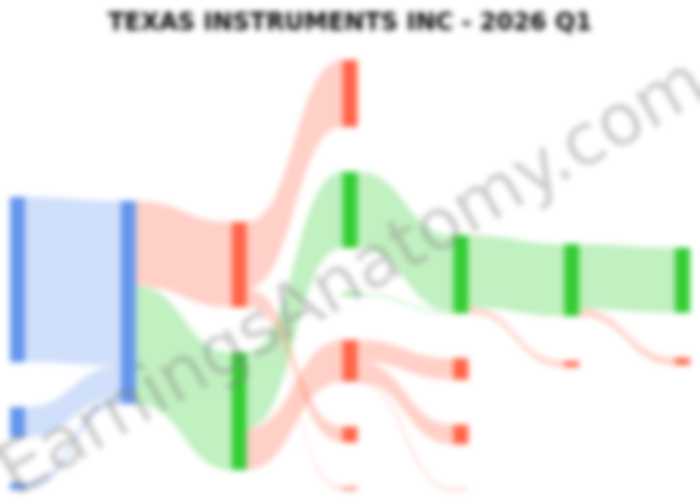
The flow from revenue to profit is illustrated below, showing how the company's two main segments, Analog and Embedded Processing, contribute to the overall financial picture.
The company’s largest segment, Analog, which includes power and signal chain products, was the primary growth engine. It posted revenue of $3.92 billion, a 22% year-over-year increase, and saw its operating profit climb an impressive 36% to $1.64 billion. The Embedded Processing segment, which supplies microcontrollers and processors, also showed robust growth, with revenue up 12% to $723 million and operating profit soaring 205% to $122 million. The "Other" segment, which includes DLP products and calculators, experienced a decline, partly due to $17 million in acquisition-related charges.
A key theme in the report is Texas Instruments' continued heavy investment in its manufacturing capabilities. The company’s strategy centers on building out its own production facilities to lower costs and gain greater control over its supply chain—a critical advantage in the often-volatile semiconductor industry. In the first quarter alone, capital expenditures reached $676 million.
These significant investments are being substantially supported by government incentives. The Consolidated Statements of Cash Flows reveal that Texas Instruments received $555 million in proceeds from the U.S. CHIPS and Science Act during the quarter. While the filing identifies these funds as direct cash proceeds that offset investing activities, this government support comes with significant conditions. To secure the funding, recipients are prohibited from expanding semiconductor manufacturing in countries of concern, like China, for ten years and must also agree to limitations on stock buybacks. This federal support is directly fueling the company's expansion, making its ambitious manufacturing roadmap more financially sustainable.
This strategy is also reflected in the company's free cash flow, a non-GAAP metric that the company defines as cash flow from operations less capital expenditures, plus proceeds from CHIPS act incentives. For the twelve months ending in March 2026, free cash flow was $4.35 billion, a remarkable 154% increase from the prior year.
Texas Instruments' Q1 2026 performance highlights a company benefiting from strong demand in its core markets while executing a long-term strategy of bolstering its manufacturing independence. The substantial financial support from the CHIPS Act is clearly accelerating these efforts, allowing the company to invest heavily in future capacity. By focusing on in-house production, TXN is positioning itself to be more resilient to global supply chain disruptions and to better serve its diverse customer base in the crucial industrial and automotive sectors.
Last updated: April 25, 2026
Explore prior quarterly filings, historical revenue breakdowns, and earnings trends.
Texas Instruments Q3 2026 10-Q: Analog Recovery Drives 78% Profit Surge & Record Free Cash Flow
Oct 23, 2026
Read
Texas Instruments Q2 2026: Analog Strength Drives Margin Expansion
Jul 27, 2026
Read
Texas Instruments 2025: Analog Strength Drives Recovery Amid Embedded Headwinds
Feb 7, 2026
Read
TXN Q3 2025: Revenue Growth Meets Margin Pressure
Oct 24, 2025
Read