Loading blog posts...
February 7, 2026 • 4 min read
While many people know Texas Instruments (TI) for their ubiquitous classroom calculators, the company is actually a semiconductor titan that powers the "nuts and bolts" of the electronics industry. Unlike companies focusing on high-performance computing for AI, TI dominates the market for Analog chips (which convert real-world signals like temperature and sound into digital data) and Embedded Processing chips (the specialized "brains" inside appliances, cars, and robots).
We are going to dig into TI’s financial results from their latest 10-K filing for the fiscal year ended December 31, 2025, to analyze their recovery trajectory and operational efficiency.
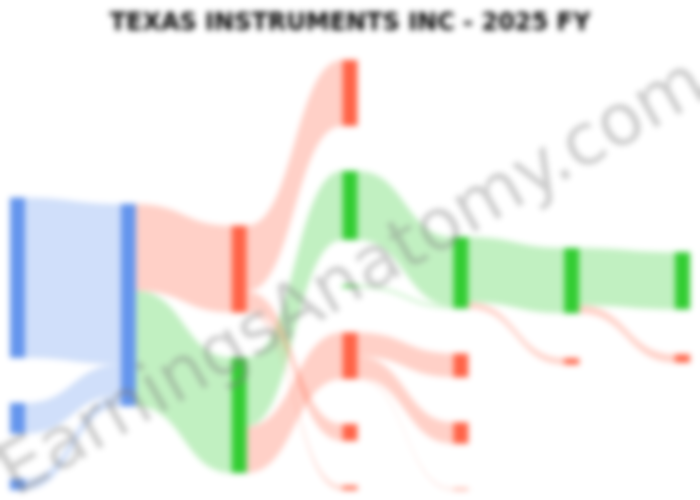
To help visualize how their top-line revenue filters down to the bottom line, take a look at the income statement flow below:
After a softer period in 2024, Texas Instruments posted a solid rebound in 2025. Total revenue grew approximately 13% year-over-year, rising from $15.6 billion in 2024 to $17.68 billion in 2025. This double-digit growth signals improving demand across their core markets, particularly in industrial and automotive sectors.
This top-line expansion flowed effectively to profitability. Net Income reached $5.00 billion, or $5.45 per diluted share, up roughly 4% from the prior year. Despite inflationary pressures, TI maintained a robust Gross Profit of $10.08 billion, showcasing the durability of their manufacturing model.
TI’s business is heavily weighted toward its Analog segment, which accounted for 79% of total revenue in 2025. This segment was the clear driver of the company's success:
In contrast, the Embedded Processing segment faced headwinds. While revenue grew modestly by 6% to $2.7 billion, profitability deteriorated. Operating profit for this segment fell 14%, and margins compressed significantly from 13.9% in 2024 down to 11.3% in 2025. This divergence suggests that while TI is shipping more embedded units, they are facing rising costs or pricing pressures that are eating into the profitability of that specific division.
Texas Instruments operates as an Integrated Device Manufacturer (IDM), meaning they design and manufacture their own chips rather than outsourcing production. This strategy requires massive capital investment but offers greater control over the supply chain.
In 2025, TI spent $4.55 billion on Capital Expenditures (CapEx) to expand manufacturing capacity. Despite this heavy spending, the company’s Free Cash Flow (FCF)—a critical metric representing the cash generated after accounting for these investments—nearly doubled to $2.94 billion (up from $1.5 billion in 2024).
This cash flow performance was bolstered by government incentives. The filing notes $335 million in proceeds related to the U.S. CHIPS and Science Act, a federal initiative designed to strengthen domestic semiconductor manufacturing.
TI's revenue is strategically diversified, insulating it from the volatility of consumer gadgets. In 2025, the Industrial and Automotive sectors each represented 33% of revenue. As factories automate and cars become increasingly electrified, TI's heavy exposure to these sectors positions them well for long-term secular growth.
However, geopolitical risks remain a factor. The filing highlights significant exposure to China, which accounted for 21% of revenue ($3.78 billion). With ongoing trade complexities and export controls in the semiconductor space, this dependency is a key variable for investors to monitor.
Texas Instruments' 2025 fiscal year marks a return to growth, driven almost entirely by the strength of its Analog division. While the Embedded Processing segment struggles with margin compression, the company’s ability to generate strong cash flow while investing billions into U.S. manufacturing demonstrates operational resilience. As the cycle turns, TI appears well-positioned to capitalize on the increasing digitization of the industrial and automotive worlds.
Last updated: February 7, 2026
Explore prior quarterly filings, historical revenue breakdowns, and earnings trends.
Texas Instruments Q3 2026 10-Q: Analog Recovery Drives 78% Profit Surge & Record Free Cash Flow
Oct 23, 2026
Read
Texas Instruments Q2 2026: Analog Strength Drives Margin Expansion
Jul 27, 2026
Read
Texas Instruments (TXN) Q1 2026: 19% Growth & CHIPS Act Funding
Apr 25, 2026
Read
TXN Q3 2025: Revenue Growth Meets Margin Pressure
Oct 24, 2025
Read