Loading blog posts...
July 27, 2026 • 4 min read
Texas Instruments’ latest quarter gives a useful snapshot of how the analog and embedded-chip cycle is progressing, and the goal here is to dig into the income statement to see what is improving, what is driving profit, and what deserves attention. The company, best known for analog semiconductors, embedded processors, power-management chips, DLP products and calculators, posted a strong Q2 with broad demand growth and significant operating leverage. Let’s unpack the numbers from TI’s latest 10-Q filing.
TI reported Q2 2026 revenue of $5.46 billion, up 23% from $4.45 billion a year ago and up 13% sequentially, according to management’s discussion. The company said growth was broad, led by industrial, data center and automotive markets — important end markets for TI’s long-lived analog and embedded products.
The more interesting point is how much of that revenue growth flowed through to profit:
That margin expansion came from a classic semiconductor setup: revenue rose much faster than cost of revenue and operating expenses. Cost of revenue increased only 13% year over year, while R&D and SG&A were essentially flat at about $1.03 billion combined. In other words, TI’s fixed-cost-heavy model worked in shareholders’ favor this quarter.
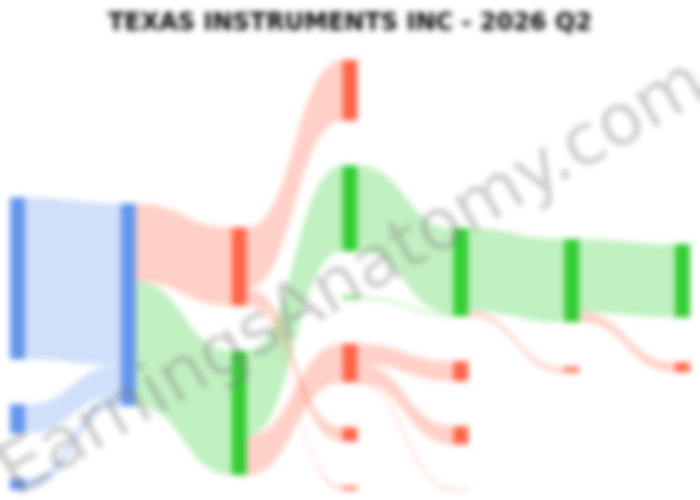
Here is a quarterly income statement flow view based on the filing:
The Analog segment — which includes TI’s Power and Signal Chain product lines — generated $4.37 billion, or about 80% of total revenue. Analog revenue rose 26% year over year, and operating profit jumped 50% to $1.99 billion, producing a 45.6% operating margin.
That is the core of the quarter. Analog chips are used to manage real-world signals like power, temperature, sound and motion, and TI benefits from selling a very broad catalog into industrial and automotive customers where product lifecycles can be long.
Embedded Processing, which includes microcontrollers and processors, also improved: revenue rose 16% to $788 million, while operating profit nearly doubled to $168 million. The margin, at 21.3%, remains well below Analog’s, but it improved sharply from 12.5% a year ago.
The Other segment, including DLP products and calculators, posted $310 million of revenue, down 2%. Its operating profit of $150 million included $17 million of acquisition charges tied to TI’s planned acquisition of Silicon Labs. Recent coverage has described that deal as focused on strengthening TI’s position in wireless and connected-edge technologies, an area adjacent to embedded processing and industrial IoT.
TI ended Q2 with $7.00 billion of cash and short-term investments, up $2.12 billion from year-end 2025. For the first six months of 2026, operating cash flow was $4.22 billion, up from $2.71 billion last year.
Capital expenditures dropped to $1.19 billion for the first half, compared with $2.43 billion a year earlier. TI also received $1.10 billion of CHIPS Act incentives during the first six months, plus used $301 million of investment tax credits to reduce taxes payable. Over the trailing 12 months, TI reported free cash flow of $6.53 billion, compared with $1.76 billion a year earlier.
Shareholder returns remained dividend-heavy: TI paid $2.59 billion in dividends in the first half, while stock repurchases were much lower at $185 million, versus $955 million last year. The company still had $18.61 billion authorized for future buybacks as of quarter-end.
This was a strong income statement for Texas Instruments: revenue accelerated, margins expanded, and net income grew much faster than sales. The quarter reinforces the power of TI’s broad analog franchise and its leverage to a recovery in industrial, automotive and data center demand.
The key watchpoints remain cyclical: semiconductor demand can shift quickly, and TI flags risks around customer inventory adjustments, trade policy, supply constraints, cybersecurity and intense competition. In a market that includes analog rivals like Analog Devices and embedded-chip competitors such as Microchip and NXP, TI’s advantage remains scale, manufacturing control and a deep catalog — and Q2 showed those strengths clearly.
Last updated: July 27, 2026
Explore prior quarterly filings, historical revenue breakdowns, and earnings trends.
Texas Instruments Q3 2026 10-Q: Analog Recovery Drives 78% Profit Surge & Record Free Cash Flow
Oct 23, 2026
Read
Texas Instruments (TXN) Q1 2026: 19% Growth & CHIPS Act Funding
Apr 25, 2026
Read
Texas Instruments 2025: Analog Strength Drives Recovery Amid Embedded Headwinds
Feb 7, 2026
Read
TXN Q3 2025: Revenue Growth Meets Margin Pressure
Oct 24, 2025
Read