Loading blog posts...
October 30, 2026 • 3 min read
Mastercard’s third-quarter income statement shows more than rising payment revenue: services supplied over half the revenue increase, while costs grew more slowly than sales. Digging into its third-quarter 2026 Form 10-Q reveals how those dynamics produced $9.8 billion in net revenue and $4.6 billion in profit—and why earnings growth deserves a closer look.
Mastercard operates a global payments network connecting banks, merchants and consumers, alongside services including fraud prevention, cybersecurity and analytics. Unlike a card-issuing bank, its core business is facilitating payments rather than lending to cardholders.
Quarterly net revenue rose 14% from $8.6 billion a year earlier. Currency-neutral growth—which removes exchange-rate effects—was also 14%, indicating that currency movements were not a material driver.
The revenue mix is particularly revealing:
Services contributed $635 million of the $1.21 billion revenue increase, or approximately 53%, despite representing only 41% of quarterly revenue. Their revenue share rose from about 40% a year earlier.
That matters because underlying payment activity grew more slowly. Mastercard-branded gross dollar volume increased 7% in local currencies, switched transactions—payments routed through Mastercard’s network—rose 9%, and cross-border volume increased 11%. Cross-border growth slowed from 15% in the prior-year quarter.
Services provided an additional source of growth as payment-volume expansion moderated. Mastercard’s September small-business research adds context: 71% of surveyed owners identified cyber protection as a priority. That illustrates demand for security tools, although it does not establish what drove this quarter’s services revenue.
Mastercard reports one operating segment, Payment Solutions, and does not disclose separate profits for these revenue categories. Faster services growth therefore does not, by itself, establish its effect on margins.
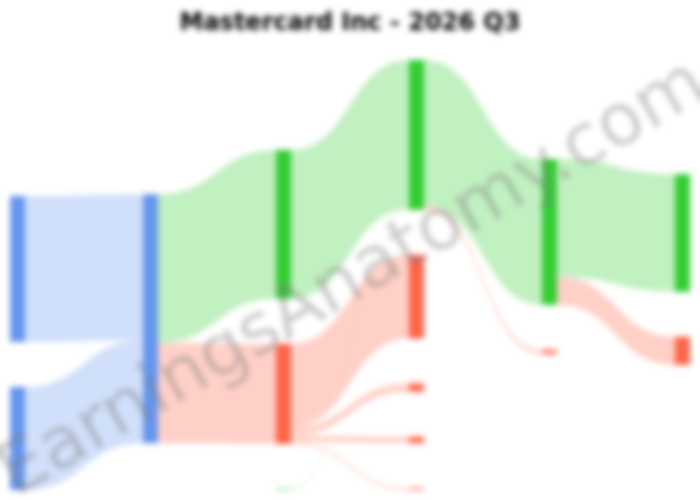
The diagram below traces the quarter’s revenue through expenses, taxes and profit.
Mastercard does not present a separate cost-of-revenue line; operating costs appear within operating expenses. That presentation should not be mistaken for an economically meaningful 100% gross margin.
Operating expenses increased 11% to $3.95 billion, below revenue growth. Operating income consequently rose 16% to $5.86 billion, with operating margin reaching 59.8%, versus 58.8% a year earlier.
This is operating leverage: revenue growing faster than supporting expenses. General and administrative expenses remained the largest cost at $3.29 billion, up 13%, while litigation provisions declined to $74 million from $83 million.
Net income rose 18%, but diluted earnings per share increased 22% to $5.28. Two additional factors helped:
EPS growth thus reflects both operating improvement and benefits below the operating-income line.
For the first nine months, net income increased 18%, yet operating cash flow fell 6% to $11.86 billion. Larger prepaid-expense outflows and litigation-related cash movements contributed to the divergence.
Cash spent on repurchases and dividends totaled $14.2 billion, exceeding operating cash flow before capital investment or acquisitions. Total debt increased to $23.94 billion, from $19.0 billion at year-end; quarterly interest expense rose to $250 million from $186 million.
Overall, Mastercard delivered strong revenue growth and improving profitability. Against Visa and alternative payment systems, services broaden its offering beyond transaction processing. Slower payment-volume growth, weaker cash conversion and continuing regulation of interchange fees and surcharging remain important counterweights to the strong earnings results.
Last updated: October 30, 2026
Explore prior quarterly filings, historical revenue breakdowns, and earnings trends.
Mastercard Q1 2026 Financials: 10-Q Income Statement Analysis
Apr 30, 2026
Read
Mastercard 2025 10-K: Services Segment Drives 16% Revenue Growth
Feb 11, 2026
Read
Mastercard Q3 2025 Filing: Revenue Hits $8.6B, Profit Jumps 20%
Oct 31, 2025
Read
Mastercard Q2 2025 Earnings: Strong Growth Meets Tax Headwinds
Aug 1, 2025
Read