Loading blog posts...
April 30, 2026 • 3 min read
Mastercard is one of the most recognizable financial brands globally, but its underlying business model is often misunderstood. The company doesn't issue credit cards or lend money. Instead, it operates a massive global network connecting consumers, financial institutions, and merchants, acting as a highly profitable gateway for digital transactions. Let's dig into the income statement from its Q1 2026 10-Q filing to see how the business is performing and what the numbers reveal about its operational momentum.
Mastercard started 2026 on a high note, reporting net revenue of $8.4 billion for the first quarter, a significant 16% increase from the $7.25 billion generated in the same period last year. This growth was broad-based, with both of its primary revenue categories showing strength:
The faster growth in value-added services highlights Mastercard's successful strategy of diversifying beyond simple transaction fees and embedding itself deeper into its clients' operations.
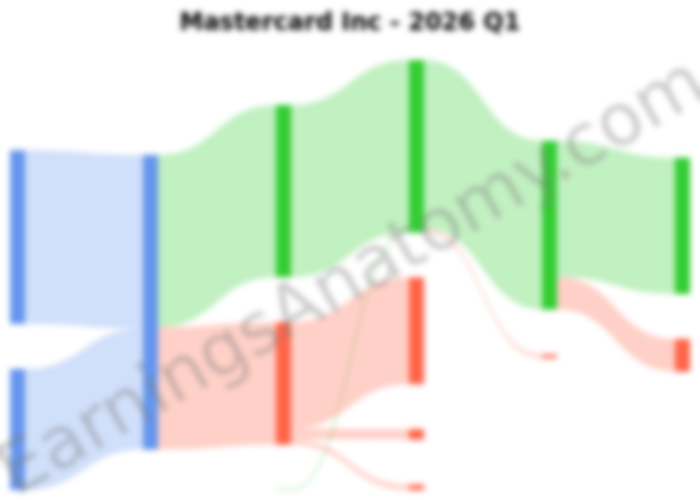
To better understand how Mastercard's revenue translates into profit, the following flow diagram illustrates the journey from gross revenue to net income for the quarter.
While revenue surged, operating expenses also climbed 13% to $3.5 billion. The primary driver was a 20% rise in general and administrative (G&A) costs, which includes personnel expenses. However, a key detail from the income statement is the $0 provision for litigation in Q1 2026, compared to a $151 million provision in Q1 2025. This absence provided a direct boost to the bottom line.
Despite the rise in G&A, the strong revenue growth and disciplined spending in other areas allowed the company to improve its profitability. Operating income grew 18% to $4.9 billion, outpacing revenue growth and pushing the operating margin up to 58.4% from 57.2% a year earlier. This demonstrates the powerful operating leverage inherent in Mastercard's scalable network model.
The strong operational performance flowed directly to the bottom line, with net income rising 18% to $3.9 billion.
Thanks to the company's aggressive share repurchase program, diluted earnings per share (EPS) grew even faster, jumping 21% to $4.35. The filing reveals that Mastercard repurchased 7.8 million shares for $4.0 billion during the quarter, underscoring its commitment to returning capital to shareholders.
In conclusion, Mastercard's first-quarter results for 2026 paint a picture of a company firing on all cylinders. It achieved robust, double-digit growth in both revenue and profit, expanded its operating margins, and continued to reward investors through substantial share buybacks. The performance of its value-added services segment, in particular, suggests a successful long-term strategy that complements its dominant payment network.
Last updated: April 30, 2026
Explore prior quarterly filings, historical revenue breakdowns, and earnings trends.
Mastercard Q3 2026 Earnings: Services Lead Growth as Cash Flow Lags
Oct 30, 2026
Read
Mastercard 2025 10-K: Services Segment Drives 16% Revenue Growth
Feb 11, 2026
Read
Mastercard Q3 2025 Filing: Revenue Hits $8.6B, Profit Jumps 20%
Oct 31, 2025
Read
Mastercard Q2 2025 Earnings: Strong Growth Meets Tax Headwinds
Aug 1, 2025
Read