Loading blog posts...
August 1, 2025 • 3 min read
In the world of digital payments, few names are as ubiquitous as Mastercard. As a global technology company, it sits at the heart of the commerce ecosystem, connecting consumers, merchants, and financial institutions. To understand its financial health and strategic direction, there's no better place to look than its quarterly filings. Let's dive into Mastercard's latest 10-Q report for the second quarter of 2025 to see how the company is performing.
Mastercard reported a robust second quarter, with net revenue climbing an impressive 17% year-over-year to reach $8.1 billion. This growth wasn't isolated to one area but was broad-based across its two main revenue streams:
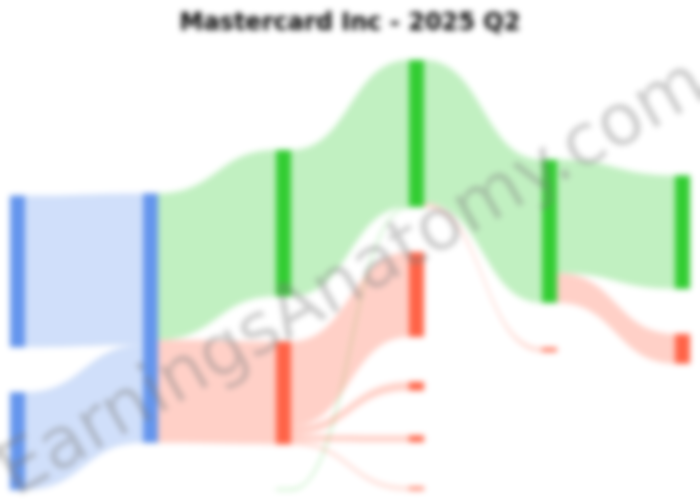
To help visualize how the company's revenue flows through its operations to become profit, I've created the following Sankey diagram based on the income statement data.
While revenues were strong, operating expenses also rose, increasing 15% to $3.4 billion. The primary driver was a 14% increase in General and Administrative costs, largely due to higher personnel expenses. Additionally, Depreciation and Amortization expenses jumped 25%, a direct result of recent acquisitions.
Despite these rising costs, Mastercard successfully improved its operating margin to 58.7% from 58.0% a year ago, a sign of effective management. However, the story changes slightly as we move down to the bottom line.
Net income grew by a solid 14% to $3.7 billion. While excellent, this growth rate lags behind the 17% revenue growth. The key reason is a significant increase in the company's effective tax rate, which jumped from 17.3% to 20.8%. The filing points to a specific cause: the implementation of the "Pillar 2" global minimum tax rules, which took effect in 2025. This is a crucial detail, showing how global regulatory changes are directly impacting the profitability of multinational corporations like Mastercard.
Even with the higher tax burden, Diluted Earnings Per Share (EPS) grew by 16% to $4.07, thanks in part to the company's ongoing share repurchase program. In the first half of 2025 alone, Mastercard bought back $4.8 billion of its own stock.
Mastercard's Q2 results paint a picture of a company firing on all cylinders. It is successfully growing its core payments business while simultaneously expanding its higher-growth services arm through strategic acquisitions.
The key challenge highlighted in this report is external. While the company navigates familiar risks like competition from Visa and fintechs, the immediate impact of new global tax regulations is now a reality. Mastercard's ability to maintain strong operating performance in the face of these headwinds will be critical. For now, the company continues to demonstrate its resilience and ability to deliver impressive growth in a complex global economy.
Last updated: August 1, 2025
Visual breakdowns and margin trends from recent public company SEC filings.
Norwegian Cruise Line Q3 2026: Higher Net Income Masks Weaker Operations
Oct 30, 2026
Read
Citizens Financial Group (CFG) Q3 2026: NII Expansion & Margin Growth
Oct 30, 2026
Read
Chubb Limited Q3 2026 10-Q Analysis: 84.1% Combined Ratio & $1.79B Investment Income
Oct 30, 2026
Read
MGM Resorts Q3 2026: Operating Profit Rebounds as Adjusted EBITDA Falls 20.4%
Oct 30, 2026
Read