Loading blog posts...
February 11, 2026 • 3 min read
Mastercard, a titan in the global payments industry, recently filed its annual report, offering a detailed look at its financial health and strategic direction. Let's dive into the numbers from their 2025 Form 10-K filing to see how the company performed and what it signals for the future of digital payments.
For the fiscal year ending December 31, 2025, Mastercard reported a strong performance, with net revenue climbing 16% to $32.8 billion. This growth translated impressively to the bottom line, as net income also saw a 16% jump to $15.0 billion.
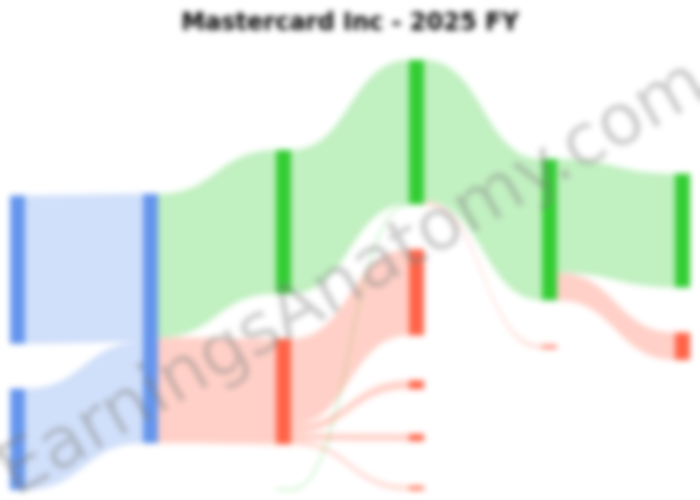
To better understand how Mastercard generates its revenue and manages its expenses, the following flow diagram visualizes the company's income statement for the year.
Mastercard's revenue is powered by two primary segments: its traditional Payment Network and its rapidly expanding Value-added Services and Solutions.
Payment Network: The company's core business, which earns fees from processing transactions (domestic, cross-border, etc.), grew by a healthy 12% to reach $19.5 billion in net revenue. This growth is fueled by fundamental metrics like a 9% increase in Gross Dollar Volume (GDV) to $10.6 trillion and a 10% rise in switched transactions, hitting 175.5 billion for the year. A particularly bright spot was the 15% surge in cross-border volume (on a local currency basis), indicating robust international travel and commerce.
Value-added Services and Solutions: This segment is increasingly crucial to Mastercard's strategy. It includes a diverse suite of offerings like cybersecurity solutions, data analytics, and customer loyalty programs. This area saw a remarkable 23% increase in net revenue, reaching $13.3 billion. This faster growth highlights Mastercard's successful push to diversify its income streams and embed itself deeper into its clients' operations beyond simple payment switching.
The filing sheds light on key initiatives from 2025 that underscore the company's forward-looking strategy. Mastercard is heavily invested in enhancing security and user experience, noting that approximately 40% of all its transactions are now tokenized—a method that replaces sensitive card details with a unique digital token to protect against fraud.
The company is also leaning into the digital asset space, expanding its crypto co-brand card programs to nearly 130 and integrating stablecoins into its Mastercard Move platform for seamless money transfers. On the branding front, a major announcement was the new partnership with the McLaren Formula 1 Team, set to begin in 2026, aiming to boost global brand visibility.
While the results are strong, the 10-K also outlines the significant challenges Mastercard faces. The "Risk Factors" section emphasizes the persistent threat of regulatory and legislative activity, particularly concerning interchange rates—the fees merchants pay to accept cards.
Competition remains fierce, not only from traditional rivals like Visa but also from emerging payment technologies and the risk of "disintermediation," where payments bypass traditional card networks altogether. This competitive pressure, combined with the need to constantly innovate amidst rapid technological change, means Mastercard cannot afford to stand still.
In conclusion, Mastercard's 2025 performance paints a picture of a company firing on all cylinders. It is successfully growing its core payments business while simultaneously building a powerful, high-growth services arm. The challenge ahead will be to maintain this momentum in an industry defined by constant disruption and regulatory scrutiny.
Last updated: February 11, 2026
Explore prior quarterly filings, historical revenue breakdowns, and earnings trends.
Mastercard Q3 2026 Earnings: Services Lead Growth as Cash Flow Lags
Oct 30, 2026
Read
Mastercard Q1 2026 Financials: 10-Q Income Statement Analysis
Apr 30, 2026
Read
Mastercard Q3 2025 Filing: Revenue Hits $8.6B, Profit Jumps 20%
Oct 31, 2025
Read
Mastercard Q2 2025 Earnings: Strong Growth Meets Tax Headwinds
Aug 1, 2025
Read