Loading blog posts...
April 28, 2026 • 3 min read
Cincinnati Financial Corporation (Nasdaq: CINF) is a major player in the U.S. insurance market, primarily offering property and casualty insurance. Unlike direct-to-consumer giants, Cincinnati Financial operates through a network of independent agents to distribute its policies to businesses and individuals. The company just kicked off 2026 with a significant financial turnaround, swinging from a loss to a substantial profit. Let's unpack the numbers from their latest 10-Q filing to see how they did it.
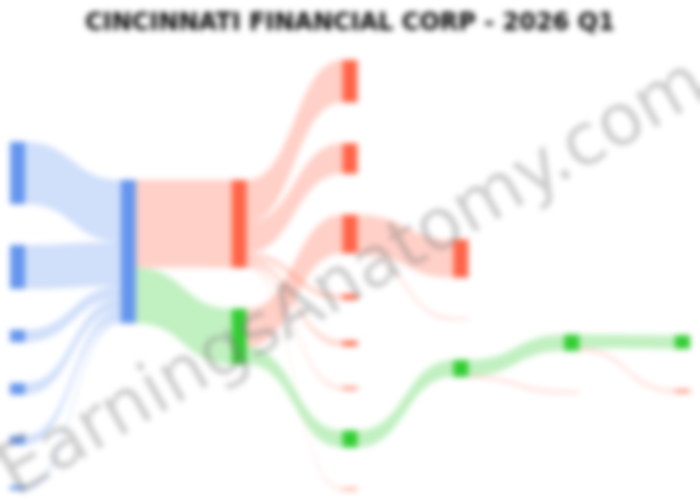
For a clearer view of where the money came from and where it went during the quarter, the following flow diagram breaks down the company's income statement.
The most striking aspect of Cincinnati Financial's first quarter is the dramatic shift in its bottom line. The company reported a net income of $274 million, a stark contrast to the $90 million net loss in the same period last year. This reversal wasn't primarily driven by revenue growth—though total revenues did climb a healthy 12% to $2.9 billion—but by a significant improvement in underwriting performance.
The key metric here is the combined ratio, which measures the total losses and expenses as a percentage of earned premiums. For an insurer, a ratio below 100% signifies an underwriting profit. CINF’s combined ratio improved dramatically to a profitable 95.6% from an unprofitable 113.3% in Q1 2025.
The main reason for this improvement was a quieter quarter for catastrophes. Insurance losses from catastrophic events like major storms fell by more than half, dropping to $285 million from $608 million a year ago.
Digging into the segment performance reveals a mixed, but telling, picture:
Personal Lines Insurance: This segment, which includes home and auto policies, was the star of the quarter. It swung from a staggering pre-tax loss of $357 million in Q1 2025 to a pre-tax profit of $30 million. The turnaround was almost entirely due to lower catastrophe losses, which were $149 million this quarter compared to $423 million in the prior-year period.
Commercial Lines Insurance: In contrast, the company's largest segment saw its pre-tax income fall from $97 million to just $18 million. Here, catastrophe losses more than doubled, increasing from $56 million to $121 million and pushing the segment's combined ratio from a solid 91.9% to a less impressive 98.6%.
Investments: The investment portfolio continued to be a reliable earnings engine, generating $318 million in pre-tax investment income, up 14% year-over-year. However, the company still recognized a $70 million net investment loss, largely due to unrealized losses on equity securities it still holds. This contributed to a slight dip in book value per share for the quarter, despite the strong operating results.
Cincinnati Financial's first-quarter results highlight a strong operational rebound, demonstrating how sensitive its profitability is to catastrophe trends. While a less severe storm season provided significant relief for the Personal Lines business, the Commercial Lines segment faced its own challenges. This divergence underscores the volatile nature of the property and casualty market. The company's steady growth in premiums and robust investment income provide a firm foundation, but its ability to maintain underwriting discipline across all segments will be crucial for navigating the inherent uncertainties of the insurance business.
Last updated: April 28, 2026
Explore prior quarterly filings, historical revenue breakdowns, and earnings trends.
Cincinnati Financial Q3 2026: Resilient Underwriting Amid Storm Losses
Oct 30, 2026
Read
Cincinnati Financial Q2 2026: Investment Gains Offset Storm Losses
Aug 2, 2026
Read
Cincinnati Financial (CINF) 2025: Strong Float Offsets Storm Losses
Feb 24, 2026
Read
CINF Q2 2025: Investment Gains Mask Catastrophe Woes
Jul 29, 2025
Read