Loading blog posts...
October 30, 2026 • 4 min read
When evaluating an insurance carrier, headline earnings can sometimes obscure the health of the underlying business. That is why our goal today is to dig into the income statement from Cincinnati Financial Corporation’s third-quarter 2026 10-Q filing to see how operations are truly progressing and what we can learn from the numbers.
Based in Fairfield, Ohio, Cincinnati Financial (Nasdaq: CINF) is one of the largest property and casualty (P&C) insurers in the United States. Operating primarily through a network of independent agencies, the company competes against industry heavyweights like Travelers, Chubb, and Progressive across commercial, personal, excess and surplus (E&S), and life insurance lines.
In the third quarter of 2026, total revenue declined 18% year-over-year to $3.05 billion, while net income dropped 59% to $459 million (or $2.96 per diluted share). However, a closer look at the income statement reveals that core insurance underwriting and recurring investment income remained resilient despite active summer storms and quieter equity markets.
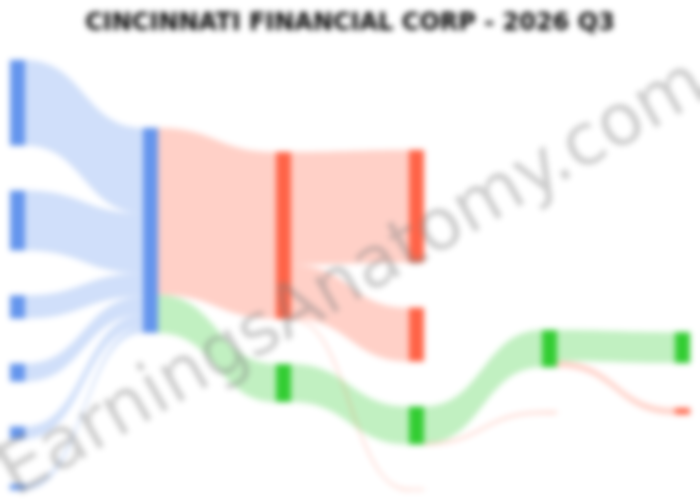
To see how premiums and investment returns filter down to the bottom line, the diagram below visualizes the company's third-quarter income statement.
In the revenue breakdown above, alongside reportable segments like Commercial Lines ($1.27 billion) and Personal Lines ($889 million), there is $266 million in unallocated revenue. This primarily represents earned premiums from Cincinnati Re (the company's assumed reinsurance business) and Cincinnati Global Underwriting Ltd. (its London-based Lloyd's syndicate), which are tracked outside the five main reporting segments.
For P&C insurers, the primary measure of operational health is the combined ratio—the sum of incurred losses and underwriting expenses divided by earned premiums. A ratio below 100% indicates an underwriting profit, meaning the insurer is making money from its policies even before investing the float.
Despite a heavy slate of third-quarter weather events—including severe storms across the Midwest, Northeast, South, and West that drove current accident year catastrophe losses up 155% to $283 million—Cincinnati Financial posted a consolidated P&C combined ratio of 90.9% and $240 million in underwriting profit.
Strip out catastrophe losses and prior-year reserve adjustments, and the underlying combined ratio actually improved by a full percentage point year-over-year to 83.7%. The company achieved this through steady pricing discipline (earned premiums rose 5% to $2.69 billion) and more selective underwriting, evidenced by a 12% pullback in agency new business written premiums—most notably a 34% reduction in personal lines new business as management tightened standards in storm-prone markets.
Segment highlights for the quarter include:
Why did net income fall from $1.12 billion in Q3 2025 to $459 million in Q3 2026? The answer lies in accounting rules for the company's $33.1 billion investment portfolio. Unlike many peers that park nearly all their assets in bonds, Cincinnati Financial allocates roughly 40% of its portfolio to common equities ($12.8 billion at fair value, heavily weighted toward tech and industrials).
Under GAAP accounting, unrealized gains and losses on equity securities held must flow directly through the income statement. In Q3 2025, a surging stock market generated $853 million in net investment gains. In Q3 2026, equity markets were relatively flat, yielding just $20 million in net investment gains. Meanwhile, core net investment income—the recurring interest and dividends collected from bonds and stocks—rose 10% to $325 million, boosted by higher bond yields on new fixed-maturity purchases averaging 5.93%.
Cincinnati Financial’s Q3 2026 report highlights the dual nature of its business model. Like competitors Chubb and Travelers, CINF faces ongoing industry challenges from severe convective storms, inflation in repair costs, and potential long-term technological shifts (the company even notes driverless cars as a long-term market risk in its filing). Yet, by pulling back on riskier new business and letting renewal rate increases take hold, its core underwriting engine is generating sub-84% underlying combined ratios, while its growing fixed-income portfolio locks in higher yields for the quarters ahead.
Last updated: October 30, 2026
Explore prior quarterly filings, historical revenue breakdowns, and earnings trends.
Cincinnati Financial Q2 2026: Investment Gains Offset Storm Losses
Aug 2, 2026
Read
Cincinnati Financial (CINF) Q1 2026: Underwriting Turnaround Drives Profit
Apr 28, 2026
Read
Cincinnati Financial (CINF) 2025: Strong Float Offsets Storm Losses
Feb 24, 2026
Read
CINF Q2 2025: Investment Gains Mask Catastrophe Woes
Jul 29, 2025
Read