Loading blog posts...
August 2, 2026 • 3 min read
Digging into a multi-line insurer’s income statement offers a clear window into how macroeconomic shifts, market swings, and weather events intersect to shape corporate performance. Cincinnati Financial Corporation (CINF), a major U.S. property and casualty insurer, recently released its financial results for the second quarter of 2026. Unpacking the numbers from their latest 10-Q filing allows us to examine how the firm navigated Q2 2026, where its profit originated, and what key takeaways emerge for investors.
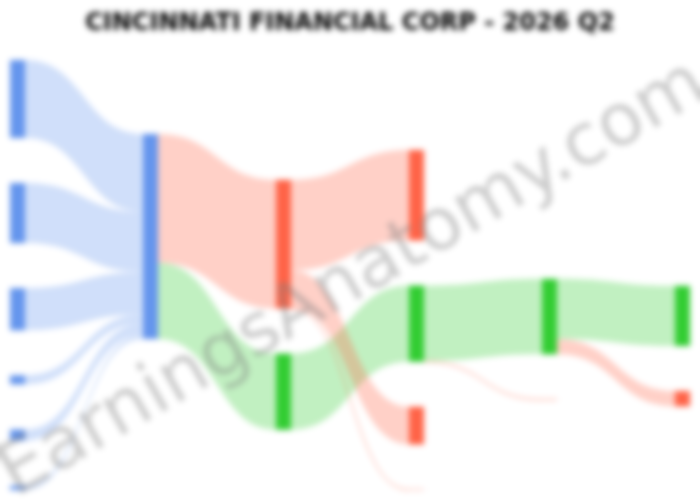
For the second quarter of 2026, Cincinnati Financial generated total revenues of $4.27 billion, a 32% increase compared to $3.25 billion in Q2 2025. Net income rose 83% to $1.255 billion ($8.05 per diluted share), up from $685 million ($4.34 per share) in the prior-year period.
Unallocated revenue during the quarter totaled $235 million, driven by $228 million in other earned premiums alongside $7 million of other revenues, including interest and fees on loans and leases.
Unlike insurers that focus primarily on fixed-income portfolios, Cincinnati Financial maintains a substantial common equity portfolio ($12.88 billion at fair value as of June 30, 2026) alongside its fixed-maturity holdings. In fact, CINF treats investments as a primary reportable operating segment, traditionally serving as its chief driver of pretax and after-tax earnings.
During Q2 2026, net investment gains reached $1.308 billion pretax, up sharply from $473 million in Q2 2025. This increase was propelled by $1.117 billion in net unrealized gains on equity securities still held, combined with $183 million in net realized gains from stock sales.
At the same time, core net investment income expanded 12% to $319 million. This growth was driven by a larger invested asset base and higher overall portfolio yields across fixed maturities—where the pretax yield reached 5.08%, up from 4.93% in Q2 2025—even as average yields on newly acquired fixed maturities slightly moderated to 5.66% from 5.82%.
While investment performance was strong, insurance underwriting operations faced pressure from severe storm activity across the Midwest, Northeast, and South. The property casualty combined ratio—a key industry metric where a ratio under 100% indicates underwriting profitability—rose to 100.8% from 94.9% in Q2 2025. Current accident year catastrophe losses contributed $365 million pretax to claims expenses.
Results across CINF's core underwriting divisions highlighted these weather-related headwinds:
Despite underwriting pressure in commercial lines, CINF’s overall capital position strengthened. Book value per share rose to $108.64, up from $102.35 at year-end 2025. The company’s Value Creation Ratio (VCR)—which measures book value growth plus declared dividends—reached 8.0% for the first six months of 2026.
Management continued its strategy of returning value to shareholders, declaring a $0.94 per share quarterly dividend (an 8% increase year-over-year) and repurchasing $215 million of common stock in Q2. As climate volatility tests underwriting discipline across the P&C industry, Cincinnati Financial’s dual engine of independent agency distribution and investment operations remains central to its business model.
Last updated: August 2, 2026
Explore prior quarterly filings, historical revenue breakdowns, and earnings trends.
Cincinnati Financial Q3 2026: Resilient Underwriting Amid Storm Losses
Oct 30, 2026
Read
Cincinnati Financial (CINF) Q1 2026: Underwriting Turnaround Drives Profit
Apr 28, 2026
Read
Cincinnati Financial (CINF) 2025: Strong Float Offsets Storm Losses
Feb 24, 2026
Read
CINF Q2 2025: Investment Gains Mask Catastrophe Woes
Jul 29, 2025
Read