Loading blog posts...
February 24, 2026 • 3 min read
Cincinnati Financial Corporation (CINF) is one of the top property casualty insurers in the United States, standing out in a crowded market by exclusively marketing its policies through independent insurance agencies. This unique relationship-driven model has helped the company build a formidable presence in both commercial and personal insurance lines, as well as life insurance.
Let's unpack the numbers from their latest 10-K filing to see how the company navigated a complex 2025 landscape marked by severe weather events and an evolving investment environment.
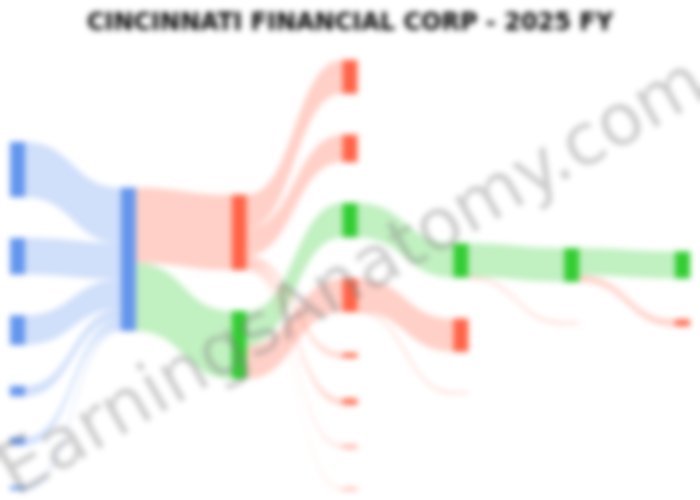
To help visualize where the money comes from and where it goes, here is a breakdown of their 2025 income statement:
A great way to measure an insurer's core operational health is by looking at premium growth and the "combined ratio." The combined ratio measures incurred losses and expenses as a percentage of earned premiums. A ratio below 100% indicates an underwriting profit, while anything above means the company is paying out more in claims and expenses than it collects in premiums.
In 2025, Cincinnati Financial delivered robust top-line growth. Total earned premiums rose 12% to $9.98 billion. However, the consolidated property casualty combined ratio ticked up slightly to 94.9%, compared to 93.4% in 2024.
The primary culprit for this increase? Catastrophe losses. The company absorbed $1.05 billion in current accident year catastrophe losses, adding 10.8 percentage points to the combined ratio. A deeper look at the segments reveals a stark contrast in how these weather events impacted the business:
Insurance companies don't just make money from underwriting; they make a substantial portion of their profits by investing the premiums they collect before claims are paid out—a pool of capital known as the "float."
In 2025, Cincinnati Financial’s investment portfolio was an absolute powerhouse, serving as a massive profit engine that more than compensated for the underwriting pressures in the Personal Lines segment. Pretax investment income, net of expenses, jumped 14% to $1.16 billion, benefiting from higher yields on newly acquired fixed-maturity securities (bonds).
Furthermore, the company recognized a staggering $1.44 billion in net investment gains. When combined with underwriting profits, this robust investment performance drove Cincinnati Financial's net income to $2.39 billion for the year, a 4% increase over 2024.
Cincinnati Financial's 2025 results offer a textbook example of why diversification matters in the insurance business. While changing climate patterns and severe weather events posed significant challenges to the Personal Lines division, the company's strong Commercial underwriting discipline and highly lucrative investment portfolio easily absorbed the shock.
As the industry grapples with the rising frequency of natural disasters and persistent inflation impacting repair costs, insurers are being forced to aggressively adjust pricing. Cincinnati Financial's ability to maintain its strong independent agent relationships while precisely managing these rate increases will be the true test of its resilience moving forward.
Last updated: February 24, 2026
Explore prior quarterly filings, historical revenue breakdowns, and earnings trends.
Cincinnati Financial Q3 2026: Resilient Underwriting Amid Storm Losses
Oct 30, 2026
Read
Cincinnati Financial Q2 2026: Investment Gains Offset Storm Losses
Aug 2, 2026
Read
Cincinnati Financial (CINF) Q1 2026: Underwriting Turnaround Drives Profit
Apr 28, 2026
Read
CINF Q2 2025: Investment Gains Mask Catastrophe Woes
Jul 29, 2025
Read