Loading blog posts...
August 2, 2026 • 4 min read
Bloom Energy has spent the past year being repriced as an AI infrastructure play rather than a perennially unprofitable clean-tech company. The San Jose–based maker of solid oxide fuel cells — refrigerator-sized "Energy Servers" that convert natural gas, biogas or hydrogen into on-site electricity without combustion — has become a favored workaround for data centers that can't wait years for a grid connection. Its second-quarter 10-Q is the clearest evidence yet that the order book is converting into shipped hardware and, for the first time at scale, real profit.
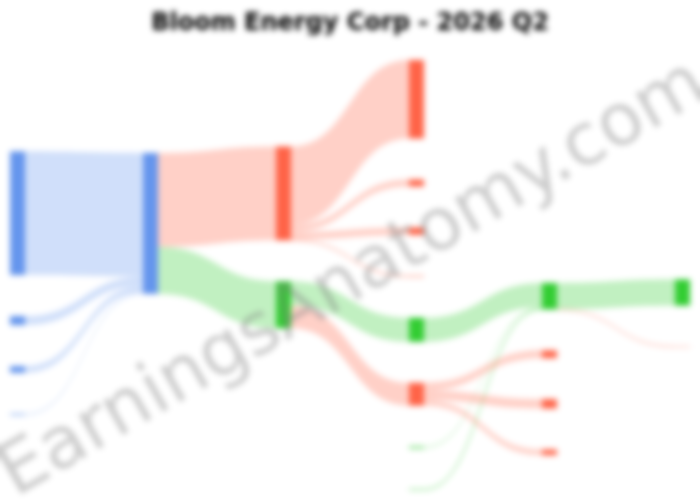
Total revenue hit $1.065 billion, up 165.5% from $401.2 million a year ago. Essentially all of that came from one line: product revenue of $935.4 million, up 215% year over year and now 88% of the top line.
That mix shift matters because product is Bloom's highest-margin business (37% gross margin this quarter). The result was total gross profit of $355.6 million at a 33.4% margin, up from 26.7% a year ago, and operating income of $182.2 million versus a $3.5 million operating loss in Q2 2025. Net income came in at $198.9 million, or $0.62 per diluted share, against a $42.2 million loss last year.
Two things flatter that bottom line. First, the income tax provision was just $1.5 million on $200.3 million of pre-tax income — Bloom still carries a $3.7 billion accumulated deficit and the associated loss carryforwards. Second, the November 2025 issuance of $2.5 billion of 0% convertible notes due 2030 replaced high-coupon debt: interest expense fell to $8.9 million while interest income on a $2.67 billion cash pile rose to $20.9 million, a net $12.0 million tailwind.
The less flattering details are in the smaller segments. Installation ran a gross loss of $1.9 million in the quarter (–$11.0 million year to date, a –14% margin), and legacy electricity revenue fell 22% to $10.0 million as Bloom shifts away from owning assets — 99% of acceptances are now direct purchase. Cost of product revenue also absorbed a specific $58.3 million warranty reserve, which pushed accrued warranty from $20.0 million at year-end to $77.8 million.
Buried in Note 3 is one of the more unusual items in the filing. Under the expanded partnership announced in April to deploy up to 2.8 GW, Bloom issued Oracle a warrant for 3.53 million shares at $113.28. Because Oracle is a customer's customer — Bloom sells into project JVs with Brookfield that ultimately serve Oracle — the $324.4 million of share value is booked as a customer consideration asset ($91.0 million current, $215.5 million long-term) and amortized as a reduction of revenue over time. Only $17.9 million has been recognized so far, meaning roughly $306 million of future revenue offset is already on the books.
Bloom also holds 9.9% passive stakes in the Brookfield "AI Fund" JVs (Bolt US JVCo entities) plus 15% of ORC HoldCo. Those equity-method holdings contributed $4.3 million of earnings in Q2 — a reversal from a $12.7 million six-month loss, implying a roughly $17 million Q1 hit as projects ramped.
Cash generation flipped decisively: $300 million of operating cash flow in the first half versus $323.8 million used a year ago, helped by customer deposits swelling from $78 million to $361 million. Working capital is nonetheless stretched — receivables plus contract assets grew $277 million and inventory $115 million.
The obvious fragility is concentration. Management disclosed on the call that a single customer accounted for roughly 73% of quarterly revenue, and full-year guidance was raised to $3.9–$4.2 billion in revenue with $800–900 million of operating income. Against GE Vernova, Caterpillar and Cummins in on-site generation — and grid-scale gas turbines with multi-year backlogs — Bloom's speed of deployment is its edge. But with 323 million diluted shares (up 39% year over year from converts and equity awards), $56.4 million of quarterly stock comp, and a newly added risk factor about short sellers, execution on that hyperscaler pipeline has to keep pace with the dilution.
Last updated: August 2, 2026
Explore prior quarterly filings, historical revenue breakdowns, and earnings trends.
Visual breakdowns and margin trends from recent public company SEC filings.