Loading blog posts...
October 23, 2026 • 3 min read
Bloom Energy Corporation (NYSE: BE), known for its solid oxide fuel cell systems that generate on-site electricity for commercial facilities, data centers, and utilities, just released its latest 10-Q filing. Amid a massive surge in electricity demand driven by artificial intelligence workloads and cloud data centers, digging into the company's income statement provides an instructive look at how rapid scaling transforms a clean-tech equipment maker's operational profile and bottom line.
For the third quarter of 2026, Bloom delivered $1.24 billion in total revenue, marking a staggering 138% year-over-year increase from $519.0 million in Q3 2025.
The primary catalyst was its core Product division—which encompasses the manufacturing and sale of its proprietary Energy Server platforms. Product revenue nearly tripled, rocketing 179% to $1.07 billion (accounting for 87% of total revenue) compared to $384.3 million in the prior-year period. Installation revenue rose 29% to $84.9 million, while recurring Service revenue climbed 15% to $67.6 million. Electricity revenue, generated from power purchase agreements and leases, came in at $9.8 million.
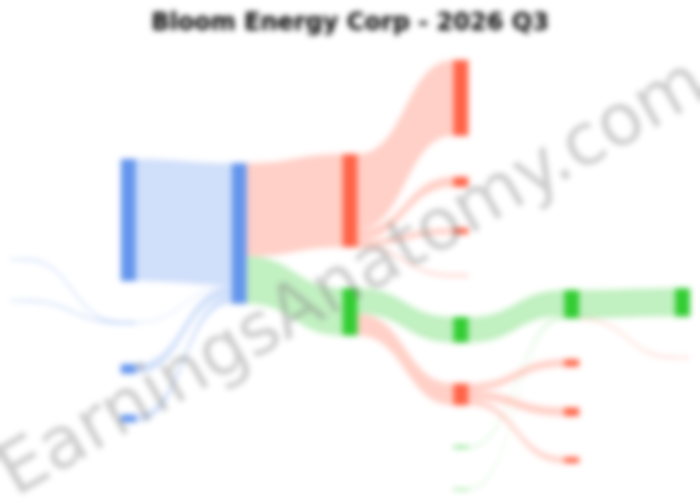
The complete flow of revenue through costs, operating expenses, and non-operating items down to net income can be seen below:
A recurring question for hardware-centric energy transition companies is whether revenue growth can outpace component and labor costs. Bloom answered emphatically this quarter:
The bottom line also benefited from net non-operating gains, including $14.6 million in net interest income—driven by an expanded cash and short-term investment cushion of roughly $2.5 billion—and $12.6 million in other net income, offsetting $2.9 million in equity losses from unconsolidated joint ventures (such as the Bolt US AI data center fund entities).
Bloom's sharp turnaround reflects its emergence as a premier provider of behind-the-meter, baseload power for power-constrained data centers. When grid connection queues stretch 4 to 7 years in major tech hubs, Bloom's ability to deploy gigawatt-scale microgrids rapidly has positioned it favorably against conventional reciprocating engine and turbine suppliers like Caterpillar, Cummins, and GE Vernova.
However, the filing highlights key operational friction points that investors should monitor. Working capital requirements surged alongside delivery milestones: accounts receivable and contract assets expanded significantly, while inventory reached $927.7 million. Management also cited broader industry challenges, including local zoning pushback against data center developments, supply chain bottlenecks, and persistent trade tariff friction.
Even with these hurdles, Bloom’s Q3 2026 performance demonstrates that on-site power generation has evolved from a niche sustainability experiment into a mission-critical utility for the computational infrastructure era.
Last updated: October 23, 2026
Explore prior quarterly filings, historical revenue breakdowns, and earnings trends.
Visual breakdowns and margin trends from recent public company SEC filings.