Loading blog posts...
March 2, 2026 • 3 min read
Berkshire Hathaway has released its 2025 annual 10-K report, offering a detailed look at the conglomerate's financial health during what was Warren Buffett's final full year as Chief Executive Officer. The filing, which precedes Greg Abel's official start as CEO on January 1, 2026, paints a picture of formidable operating strength offset by significant write-downs on major investments.
While reported net earnings fell to $67.0 billion from $89.0 billion in 2024, a closer look reveals that the company's core businesses continue to perform exceptionally well. As Berkshire frequently advises, the wild swings in its investment portfolio can obscure the underlying performance of its operating companies.
Berkshire's insurance and railroad segments remain the twin engines driving its profitability. The insurance operations delivered an impressive $7.3 billion in after-tax underwriting earnings. Though down from a record $9.0 billion in 2024, the result highlights the segment's disciplined approach. The group's "float"—the premiums held and invested before claims are paid—grew to a massive $176 billion at the end of 2025.
BNSF Railway also demonstrated its critical role in the American economy and Berkshire's portfolio, increasing its pre-tax earnings by 7.9% to $7.2 billion. Notably, this profit growth was achieved on essentially flat revenues, pointing to significant gains in operational efficiency and cost management.
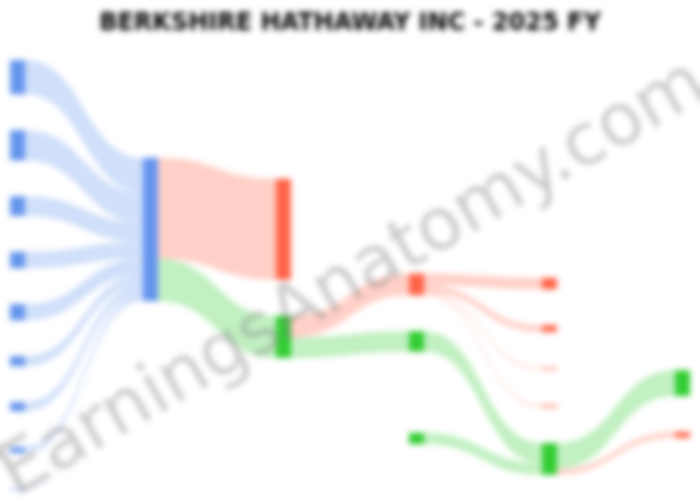
The following flow diagram illustrates how revenue and expenses from Berkshire's diverse operations contributed to its bottom line in 2025.
The most significant event disclosed in the filing was the decision to record other-than-temporary impairment losses on two major equity-method investments. An impairment charge is a non-cash expense recognized when a company determines that an asset's value has declined and is not expected to recover.
Berkshire recognized pre-tax impairment losses of approximately $5.0 billion on its investment in The Kraft Heinz Company and $5.7 billion on its stake in Occidental Petroleum. These substantial write-downs, totaling a combined $10.7 billion pre-tax, reflect prolonged underperformance and a judgment that the carrying value of these investments on Berkshire's books was no longer fully recoverable in the near term. This move underscores the headwinds facing both companies and explains a significant portion of the decline in Berkshire's net earnings.
Not all of Berkshire's operating units fired on all cylinders. The Service and Retailing group saw a significant decline, driven by a 69.1% drop in pre-tax earnings at Pilot Travel Centers, which fell to $190 million.
Meanwhile, the Berkshire Hathaway Energy (BHE) segment faces a shifting regulatory landscape. The filing notes the enactment of the "One Big Beautiful Bill Act," new legislation that accelerates the phase-out of certain federal tax credits. BHE states this could affect the "economics and viability" of future renewable energy, storage, and other clean-tech projects.
As the company closes the books on 2025, the results showcase the enduring cash-generating power of the core businesses Buffett assembled. The coming year will see Greg Abel formally take the CEO reins, tasked with steering the conglomerate, managing its vast portfolio, and navigating the challenges and opportunities that lie ahead, from new energy regulations to addressing underperforming assets.
Last updated: March 2, 2026
Explore prior quarterly filings, historical revenue breakdowns, and earnings trends.
Visual breakdowns and margin trends from recent public company SEC filings.