Loading blog posts...
October 22, 2026 • 3 min read
Managing millions of tons of municipal and industrial trash might not sound glamorous, but the solid waste sector has long been an attractive showcase of resilient business models and steady pricing power. Waste Connections, Inc. (NYSE: WCN), the third-largest solid waste management provider in North America behind industry giants Waste Management and Republic Services, operates primarily in exclusive and secondary markets across 46 U.S. states and six Canadian provinces. To understand how the company is executing amid economic crosscurrents and stubborn inflation, we dig into the income statement from its latest 10-Q filing to see where revenue originates, how costs are tracking, and what insights can be learned from its recent operating momentum.
For the third quarter of 2026, Waste Connections generated total revenues of $2.64 billion, up 7.3% from $2.46 billion in the prior-year period. Net income climbed 25.5% year-over-year to $359.2 million, driving diluted earnings per share up from $1.11 to $1.43.
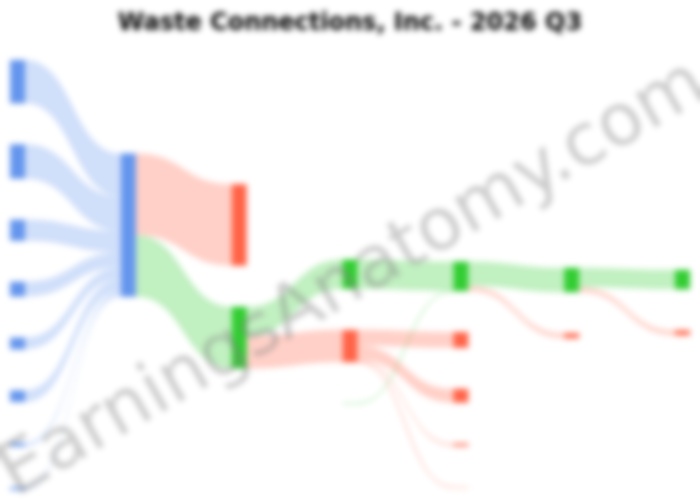
The visual breakdown below illustrates the journey from revenue streams to bottom-line profitability for the quarter:
Because Waste Connections reports direct costs of operations on a consolidated basis and by geographic operating segment rather than by service line, operating costs and expenses in the flow chart appear directly against consolidated gross revenue.
A close look at revenue components highlights the industry's defining advantage: strong contract pricing. Of the $179.7 million year-over-year revenue increase in the quarter:
Waste Connections deliberately shed lower-margin, non-exclusive volume while maintaining price discipline, a playbook that protects profitability even when commercial activity softens. Meanwhile, Exploration and Production (E&P) waste services revenue rose to $212.9 million (up 18.8% year-over-year), bolstered by expanded treatment capacity and active drilling and production in Canada and the Southern region.
Operating income surged 23.2% to $541.7 million, pushing the operating margin up 260 basis points to 20.5%. While cost of operations rose 6.7% to $1.50 billion—driven by diesel fuel prices, higher labor, and vehicle maintenance—operating margins benefited substantially from a dramatic drop in special operating charges.
Impairments and other operating items fell from $60.1 million in Q3 2025 to just $1.9 million in Q3 2026. Prior periods carried significant remediation and environmental charges, including costs related to managing the elevated temperature landfill (ETLF) event at the Chiquita Canyon Landfill in California. Adjusted EBITDA—which adds back depreciation, amortization, and special non-recurring costs—reached $895.8 million, up 7.9% from $830.3 million a year ago.
Waste Connections returned meaningful capital to shareholders, repurchasing nearly 1.97 million shares for $329.9 million in the quarter alone while raising its quarterly cash dividend to $0.35 per share.
Looking ahead, solid waste leaders face elevated labor expenses, geopolitical volatility affecting fuel costs, and potential equipment tariffs across the U.S.–Canada border. Yet Waste Connections’ vertically integrated footprint—controlling over 115 disposal sites—alongside its secondary market focus, insulates it from head-to-head pricing wars. With disciplined pricing continuing to outstrip inflation and volume drag, the company remains well-positioned to maintain healthy cash conversion and sustained earnings quality.
Last updated: October 22, 2026
Explore prior quarterly filings, historical revenue breakdowns, and earnings trends.
Visual breakdowns and margin trends from recent public company SEC filings.