Loading blog posts...
July 26, 2026 • 3 min read
Trash may not be glamorous, but it is one of the most reliable businesses in North America. Waste Connections, Inc. is the continent's third-largest solid waste operator, behind Waste Management and Republic Services. Unlike its larger peers, Waste Connections focuses primarily on exclusive and secondary markets—suburban and rural areas with less competition—while also offering non-hazardous exploration and production (E&P) waste treatment and disposal for oil and gas operations. In this post, we will dig into the income statement from the company's latest 10-Q filing to see how things are going, evaluate its core growth drivers, and extract key insights from its recent financial performance.
For the second quarter ended June 30, 2026, Waste Connections generated total revenue of $2.56 billion, a 6.4% increase compared to $2.41 billion in Q2 2025. Growth was propelled by strong pricing discipline: the company implemented $121.8 million in core price increases alongside $24.5 million in surcharges. This pricing power helped offset $64.1 million in volume declines in roll-off and commercial collection across its Eastern, Southern, and Canadian regions.
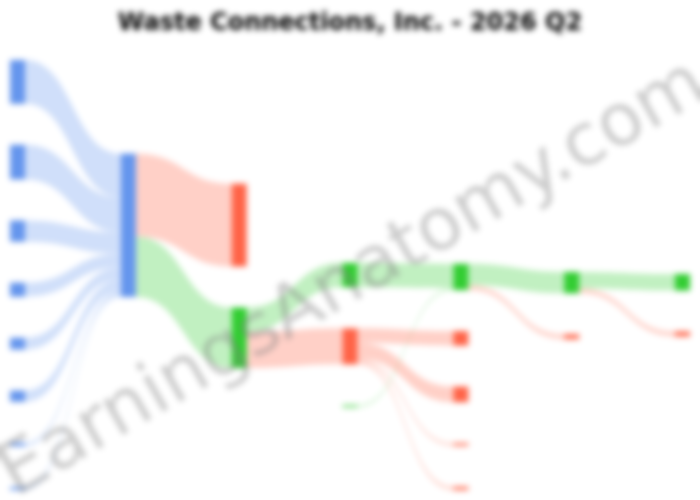
The visual flow below illustrates how Q2 2026 revenues flowed through costs, operating expenses, and tax provisions down to net income:
Despite top-line expansion, GAAP operating income fell to $437.6 million from $459.5 million a year earlier, driving operating margin down from 19.1% to 17.1%. Net income rose slightly to $296.4 million ($1.17 diluted EPS), compared to $290.3 million ($1.12 diluted EPS) in Q2 2025.
The compression in operating margin was primarily caused by a spike in "Impairments and other operating items" to $58.5 million, up from $4.0 million in the prior-year period. A major contributor is the ongoing remediation at the Chiquita Canyon Landfill in California, which has been managing a complex subsurface elevated temperature event that generates heat, odors, and liquid leachate. The site ceased accepting waste in January 2025, leading to substantial closure liability adjustments ($132.0 million in the first half of 2026) and elevated impairment charges.
Looking past these GAAP charges, the underlying business performed strongly. Adjusted EBITDA—a non-GAAP metric measuring cash operating profit excluding one-time items—increased 6.8% to $840.1 million. Adjusted diluted EPS grew to $1.50 from $1.29. E&P waste disposal was a notable growth driver, with revenues rising $23.4 million year-over-year due to higher drilling activity and supportive energy prices.
From an operational standpoint, Canada was the most profitable geographic division, delivering a 43.5% segment EBITDA margin. Collection services—commercial ($783.3M), residential ($619.7M), and industrial roll-off ($380.8M)—formed the foundation of the business, accounting for nearly 70% of total revenues.
Waste Connections continues to combine capital investments with direct shareholder returns. During the first six months of 2026, the company deployed $614.5 million toward share repurchases and distributed $177.1 million in dividends, following an 11% dividend rate increase in late 2025. Total long-term debt reached $9.28 billion, supported by the issuance of $600 million in 4.80% Senior Notes due 2036 during the first quarter.
Waste Connections demonstrates the defensive strengths typical of the solid waste sector, using pricing power and market positioning to drive revenue growth. While remediation costs at Chiquita Canyon represent an ongoing operational headwind, solid adjusted EBITDA growth and steady cash generation indicate that the company's core operating engine remains healthy as it competes in the North American waste market.
Last updated: July 26, 2026
Explore prior quarterly filings, historical revenue breakdowns, and earnings trends.