Loading blog posts...
February 6, 2026 • 4 min read
For anyone looking to understand the mechanics of the internet's infrastructure, diving into the financial statements of Verisign Inc. (VRSN) is an essential exercise. As the exclusive registry operator for the .com and .net top-level domains (TLDs), Verisign effectively operates the "address book" for the most valuable real estate on the web.
We are going to dig into their latest 10-K filing for the fiscal year ended December 31, 2025, to analyze their income statement, profitability, and what these numbers tell us about the health of the domain name industry.
Before looking at the numbers, it is important to understand Verisign's unique position. They function as a wholesaler. When you buy a .com domain from a registrar like GoDaddy or Namecheap, those companies pay Verisign a fee. Because Verisign operates under agreements with ICANN (Internet Corporation for Assigned Names and Numbers) and the U.S. Department of Commerce, they possess a regulated monopoly over the .com extension. This position allows for incredibly predictable revenue streams, though their ability to raise prices is strictly governed by these contracts.
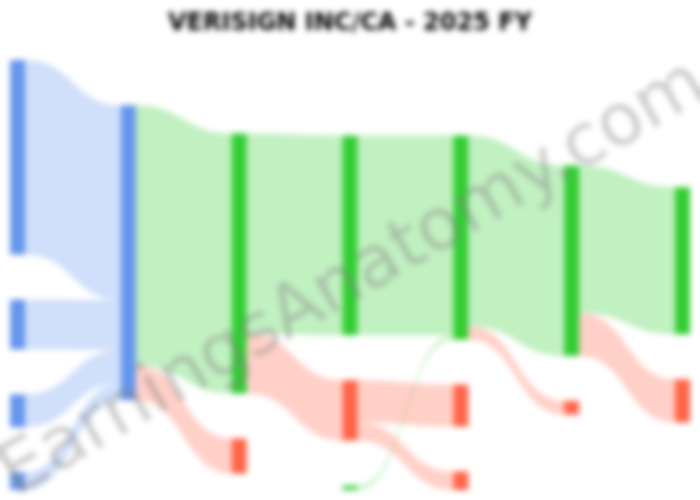
To visualize how efficient this business model is, take a look at the flow of their financials below, which tracks revenue from the top line down to the bottom line:
Verisign’s financial engine continued to hum along in 2025. The company reported revenues of $1.66 billion, a 6% increase compared to the previous year. This growth was driven by two main factors: an increase in the domain name base and contractually permitted price increases for .com and .net domain names.
The scale of their operation is massive. By the end of 2025, the domain name base for .com and .net totaled 173.5 million registrations, up 2.6% from 2024. Furthermore, the registry processed 41.7 million new domain name registrations during the year, a significant jump from 37.4 million in 2024, signaling continued demand for online presence despite broader economic fluctuations.
The most striking aspect of Verisign's income statement is its profitability profile.
With such high margins and relatively low capital expenditure requirements (it doesn't cost much incrementally to add a domain to a database), Verisign generates substantial cash flow. Operating cash flow for 2025 was $1.09 billion.
Management has been aggressive in returning this capital to shareholders. In 2025, they utilized $881.6 million for share repurchases. Additionally, the company initiated a quarterly dividend in April 2025, paying out $215.2 million in dividends throughout the year. This marks a shift toward a balanced return of capital strategy, appealing to both growth and income-focused investors.
While the financials are pristine, the risks are largely regulatory and structural. The company notes in its risk factors that any loss or modification of its right to operate the .com registry would be catastrophic. Furthermore, while .com remains the gold standard, the internet is slowly diversifying with alternative TLDs (like .io, .ai, or .shop), though none yet pose a genuine threat to Verisign's dominance.
In summary, Verisign’s 2025 10-K depicts a company that acts as a highly efficient toll road for the internet. With limited competition in its specific niche and a regulatory framework that allows for modest price hikes, Verisign remains a case study in high-margin, low-volatility business operations.
Last updated: February 6, 2026
Visual breakdowns and margin trends from recent public company SEC filings.
Norwegian Cruise Line Q3 2026: Higher Net Income Masks Weaker Operations
Oct 30, 2026
Read
Citizens Financial Group (CFG) Q3 2026: NII Expansion & Margin Growth
Oct 30, 2026
Read
Chubb Limited Q3 2026 10-Q Analysis: 84.1% Combined Ratio & $1.79B Investment Income
Oct 30, 2026
Read
MGM Resorts Q3 2026: Operating Profit Rebounds as Adjusted EBITDA Falls 20.4%
Oct 30, 2026
Read