Loading blog posts...
October 30, 2026 • 3 min read
MGM Resorts International returned to operating profitability in the third quarter of 2026, but its underlying adjusted earnings weakened. A closer look at the casino and hotel operator’s September 2026 income statement reveals why: lower accounting charges lifted reported profit even as room pricing and resort margins came under pressure.
Quarterly revenue declined 0.9% to $4.21 billion, while operating income reached $118.7 million, reversing a $112.9 million operating loss a year earlier. That left an operating margin of just 2.8%.
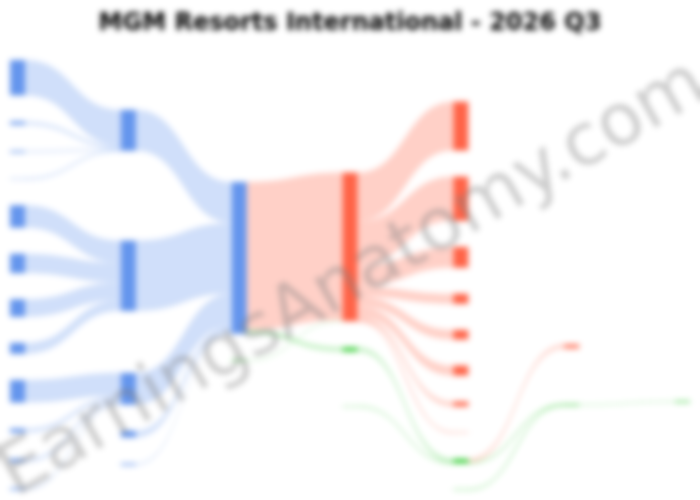
The quarterly revenue-to-profit flow shows how much of MGM’s revenue was absorbed by expenses:
The biggest explanation for the turnaround was lower operating charges. Third-quarter 2025 included a $256.1 million goodwill impairment—a write-down of acquired business value—and $101.8 million in net property-transaction expenses. This quarter had no goodwill impairment and only $7.6 million in property-transaction expenses. The combined reduction exceeded the entire $231.5 million improvement in operating income.
Meanwhile, consolidated adjusted EBITDA fell 20.4% to $402.8 million. This adjusted earnings measure excludes interest, taxes, depreciation, amortization and certain other items; it is not cash flow.
Interest expense absorbed $102.6 million, leaving pretax income of $21.9 million. A $17.3 million tax benefit raised consolidated net income to $39.2 million. However, $56.3 million of earnings belonged to noncontrolling interests—outside owners of consolidated subsidiaries—leaving a $17.1 million loss attributable to MGM, or $0.07 per diluted share.
MGM’s physical resorts showed different revenue trends but a shared challenge: weaker adjusted profitability.
Las Vegas Strip Resorts: Revenue fell 1.5% to $1.95 billion, while segment adjusted EBITDAR declined 11.7% to $530.8 million. EBITDAR excludes interest, taxes, depreciation, amortization and rent, with additional company adjustments. Occupancy held at 89%, but average daily room rates fell from $236 to $218, while payroll increased 6.8% to $682.4 million. Stable occupancy therefore did not translate into stable room revenue or earnings.
Regional Operations: Reported revenue fell 7.7% to $883.2 million, partly reflecting the sale of MGM Northfield Park. Excluding the disposed property, same-store revenue increased 1.1%, but same-store adjusted EBITDAR declined 6.6% to $242.6 million. Reported segment EBITDAR fell 17.9%. The distinction matters: the retained portfolio generated slightly more revenue but less adjusted profit.
MGM China: Revenue from MGM Macau and MGM Cotai increased 4.6% to $1.14 billion, yet adjusted EBITDAR fell 7.0% to $264.0 million. Main-floor table-game wagering volume declined 9.6%, while the casino’s win percentage rose from 24.7% to 27.7%. Higher revenue consequently did not signal stronger wagering activity.
MGM Digital, including LeoVegas and other consolidated online-gaming businesses, increased revenue 5.5% to $183.7 million and narrowed its adjusted EBITDAR loss from $23.2 million to $4.2 million, supported by lower marketing and payroll expenses.
Separately, MGM’s share of operating income from BetMGM North America rose to $26.7 million, from $23.7 million. BetMGM is its online sports-betting and gaming joint venture with Entain, rather than part of consolidated MGM Digital revenue.
Expansion carries regulatory risk: the filing says MGM Digital suspended Brazilian operations in September following a temporary government ban on fixed-odds betting and online casino games.
The takeaway: Lower operating charges improved MGM’s headline results, but resort profitability weakened. Against competing casino operators and travel destinations, the central challenge is converting revenue into earnings despite lower room rates, higher labor costs and substantial rent obligations. Digital progress helped, but did not offset the broader pressure.
Last updated: October 30, 2026
Explore prior quarterly filings, historical revenue breakdowns, and earnings trends.