Loading blog posts...
April 24, 2026 • 3 min read
If you have a store credit card in your wallet, there's a high chance it's powered by Synchrony Financial. As one of the largest issuers of private-label credit cards in the United States, Synchrony acts as the financial engine behind major retail brands, healthcare financing (through its CareCredit platform), and auto service centers. Because their business is intimately tied to everyday consumer spending and borrowing, digging into their latest 10-Q filing is an excellent way to gauge both the health of the consumer and the company's operational strength. Let's look at how the income statement flowed this quarter to generate their profit.
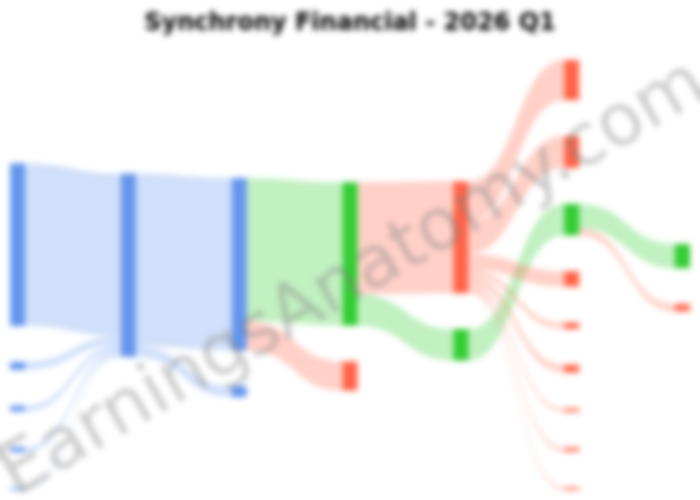
For the first quarter of 2026, Synchrony reported a net income of $805 million, a notable increase from the $757 million earned in the same period last year. This growth wasn't driven by a huge surge in revenue, but rather by careful management of its biggest risk: credit losses. The following flow diagram provides a visual breakdown of how Synchrony generated its profit for the quarter.
The most significant factor behind the earnings beat was a $156 million decrease in the provision for credit losses, which fell to $1.34 billion from $1.49 billion a year ago. The provision for credit losses is the amount set aside to cover potential loan defaults, and a lower number is a strong positive signal. This improvement was primarily driven by a drop in net charge-offs—loans the company doesn't expect to collect. The annualized net charge-off rate as a percentage of average loans fell to 5.42% from 6.38% in the prior year, indicating a healthier loan portfolio. While delinquency rates remained stable, the reduction in actual losses provided a significant lift to the bottom line.
Despite the improved credit picture, Synchrony isn't standing still. The company continues to see healthy consumer engagement, with purchase volume rising 5.6% to $43.0 billion. This growth was led by its Digital and Diversified & Value platforms, suggesting robust spending in those segments.
Interestingly, while customers are spending more, they are also paying down their balances at a faster clip. This led to total loan receivables remaining flat at around $100 billion compared to the prior year. While a positive for credit quality, it presents a challenge for growing the loan book. To counteract this, Synchrony continues to expand its network, announcing renewals with key partners like Harbor Freight and Miracle-Ear and adding new ones such as Indian Motorcycle.
A key expense to watch is the retailer share arrangements, which are payments made to partners for the value generated by the credit programs. This cost rose by $175 million to $1.07 billion for the quarter, reflecting the value of these crucial relationships.
Synchrony's strong financial position allows it to return a significant amount of capital to its shareholders. During the quarter, the company repurchased $900 million of its common stock and paid out $104 million in dividends. This robust capital return strategy signals management's confidence in the stability and profitability of its business model.
In conclusion, Synchrony Financial's first quarter of 2026 paints a picture of a company successfully navigating the economic landscape. The key takeaway is the marked improvement in credit quality, which directly boosted profitability. Coupled with steady consumer spending and a commitment to shareholder returns, Synchrony has started the year on a solid footing. The main challenge ahead will be to continue growing its loan portfolio while maintaining its disciplined approach to credit risk.
Last updated: April 24, 2026
Explore prior quarterly filings, historical revenue breakdowns, and earnings trends.
Visual breakdowns and margin trends from recent public company SEC filings.