Loading blog posts...
October 23, 2026 • 4 min read
Synchrony Financial (NYSE: SYF) is one of the largest providers of private-label and co-branded consumer credit in the United States, powering store credit cards, installment loans, and health financing programs (such as CareCredit) for major retail and healthcare partners. Today, the goal is to dig into the income statement from the company’s latest Q3 2026 10-Q filing to see how things are going, examine its core revenue drivers, and learn how consumer credit trends and partner economics are shaping its bottom line.
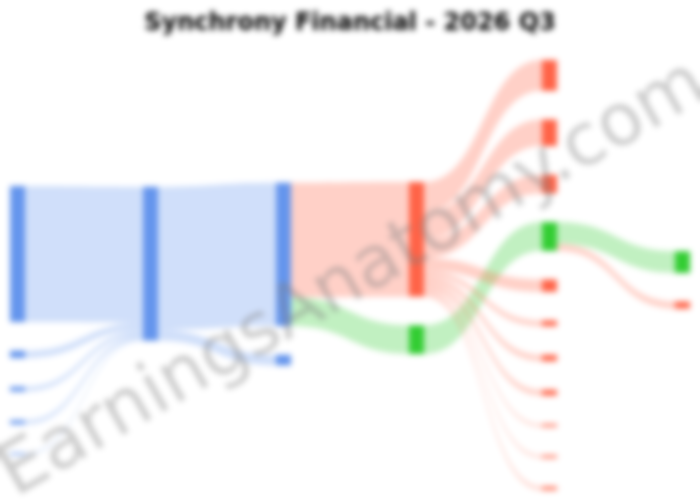
In the third quarter of 2026, Synchrony generated $5.89 billion in total gross revenue (comprising $5.79 billion in total interest income and $105 million in non-interest other income). Because Synchrony operates as a bank and consumer lender, its financial flow looks quite different from a standard retailer or software company.
The diagram above illustrates how Synchrony's quarterly revenue flows through its various cost centers down to $892 million in net earnings (or $2.68 per diluted share).
Over 94% of Synchrony's top line comes from interest and fees on loans ($5.59 billion), driven by an average loan portfolio of $102.3 billion yielding an average rate of 21.69%. Meanwhile, non-interest income ($105 million net) reveals an interesting dynamic: Synchrony earned $302 million in interchange revenue (fees paid by merchants when customers swipe their cards) and $168 million from protection products (like debt cancellation plans), but these were heavily offset by $439 million in loyalty program costs—the cash-back and rewards paid out to cardholders to keep them spending, which are recorded as contra-revenue.
On the expense side, Synchrony's largest outflows are tied directly to funding, credit risk, and partner sharing:
Despite macroeconomic questions around consumer resilience, Synchrony’s purchase volume rose 8.0% year-over-year to $49.7 billion. Growth was led by its Diversified & Value platform ($17.4 billion in volume, featuring major discount and department chains), Digital ($14.7 billion, covering online-first retail and payment networks), and Home & Auto ($12.1 billion, spanningpartners like Lowe's, Harbor Freight, and La-Z-Boy).
Interestingly, credit quality actually improved compared to last year, yet provisions and operating expenses still weighed on year-over-year net earnings (which fell from $1.08 billion in Q3 2025):
In the competitive consumer finance arena—where Synchrony goes head-to-head with private-label peer Bread Financial, as well as banking giants like Capital One, Citigroup, and JPMorgan Chase—balancing credit discipline with partner growth is everything. Synchrony's Q3 results show a healthy uptick in consumer purchase volume, lower deposit funding costs, and improving charge-off rates. If management can rein in rising fraud losses and leverage its new AI and digital investments to keep operating efficiency in check, its expanding loan book and aggressive share buybacks position it well heading into the holiday shopping season.
Last updated: October 23, 2026