Loading blog posts...
October 30, 2026 • 3 min read
Seagate’s latest results show how higher pricing can transform profitability without a comparable increase in shipments. Digging into its fiscal first-quarter 2027 Form 10-Q, covering the three months ended October 2, 2026, helps explain what drove the gains—and how much translated into cash. The storage manufacturer reported 61% year-over-year revenue growth, while net income more than tripled.
Seagate makes data storage products, chiefly hard disk drives (HDDs), competing with Western Digital and Toshiba. Data center markets accounted for 81% of quarterly revenue, underscoring its exposure to enterprise storage demand.
Revenue reached $4.23 billion, versus $2.63 billion a year earlier and $3.63 billion in the preceding quarter. Net income rose to $1.76 billion, from $549 million a year ago, and diluted earnings per share increased from $2.43 to $7.59.
The sequential comparison reveals the most important driver. Revenue grew 16.6%, but hard drive storage capacity shipped increased less than 1%, from 218 to 220 exabytes. An exabyte equals one billion gigabytes. Management attributed the $604 million sequential revenue increase primarily to favorable pricing actions.
That distinction matters: this quarter’s revenue acceleration was not primarily a surge in storage capacity shipped. Seagate earned substantially more revenue against a broadly similar shipment base.
Original equipment manufacturers, or OEMs, contributed $3.41 billion, approximately 81% of sales. Distributor revenue more than doubled year over year to $626 million, while retailer revenue increased 14% to $193 million. These are sales channels within a single reportable segment—not separate operating divisions.
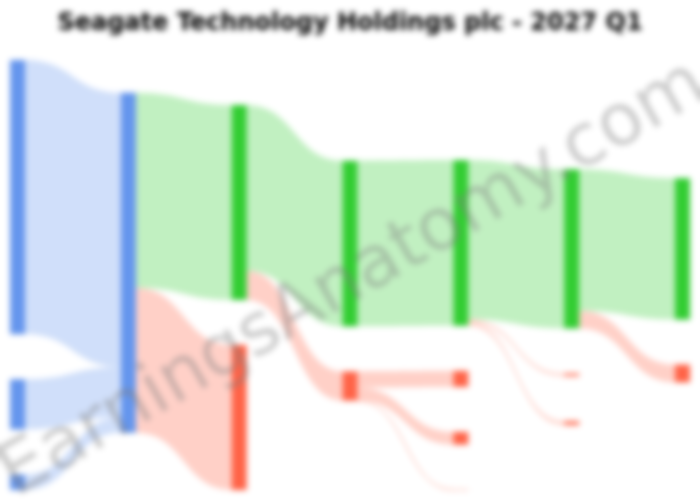
The quarterly income-statement flow illustrates how revenue translated into earnings:
Cost of revenue totaled $1.81 billion and is not allocated among sales channels in the filing. Its consolidated presentation does not represent a separate unusual charge.
Gross margin—the share of sales remaining after production costs—reached 57.3%, up from 39.4% a year earlier and 52.3% in the preceding quarter. Revenue increased 61% year over year, while cost of revenue rose only 13%.
Operating expenses excluding production costs increased just 5.8% to $363 million: $200 million for product development, $159 million for marketing and administration, and $4 million for restructuring and other charges.
Consequently, operating income nearly tripled to $2.06 billion, producing a 48.8% operating margin, versus 26.4% a year earlier. Approximately 85% of incremental year-over-year revenue became incremental operating profit—a striking example of operating leverage, where revenue grows faster than costs.
Below the operating line, interest expense fell from $80 million to $41 million. However, a $44 million loss from debt transactions helped keep total net nonoperating expense at $82 million.
Operating cash flow reached $1.69 billion. Subtracting $211 million in capital expenditures leaves $1.48 billion in free cash flow, a measure of cash remaining after investment in property and equipment.
Seagate spent $1.26 billion on debt redemptions and repurchases, alongside $400 million in share repurchases and $168 million in dividends. Debt net of issuance costs declined from $3.57 billion to $2.35 billion, although cash and equivalents also fell from $1.70 billion to $1.26 billion.
The takeaway: Higher pricing, restrained expense growth, and strong cash generation materially strengthened Seagate’s finances. Maintaining those margins remains important in a competitive storage market exposed to pricing pressure and changing customer demand. The filing also identifies $706 million in long-term taxes payable under Pillar Two global minimum tax rules, a substantial obligation alongside its improved debt position.
Last updated: October 30, 2026
Explore prior quarterly filings, historical revenue breakdowns, and earnings trends.
Seagate FY2026: Revenue Up 34% to $12.2B as HAMR Cuts Cost Per Exabyte 15%
Aug 6, 2026
Read
Seagate (STX) Q3 2026: Surging Demand Drives $3.11B Revenue
Apr 30, 2026
Read
Seagate Q2 2026: Data Center Demand Drives Margin Expansion
Jan 31, 2026
Read
Seagate's 2025 10-K: Mass Capacity Pivot Drives Record Profitability
Aug 3, 2025
Read