Loading blog posts...
April 30, 2026 • 3 min read
Seagate Technology Holdings plc (STX) is a linchpin of the global digital economy. As a leading innovator in mass-capacity data storage, Seagate—alongside its primary rival Western Digital—forms a practical duopoly that supplies the high-capacity hard disk drives (HDDs) powering the world's cloud infrastructure and enterprise data centers. With the recent explosion in data generation, the need to store massive amounts of information has skyrocketed. Let's unpack the numbers from their latest quarterly filing to see how this translated into financial performance for the quarter ended April 3, 2026.
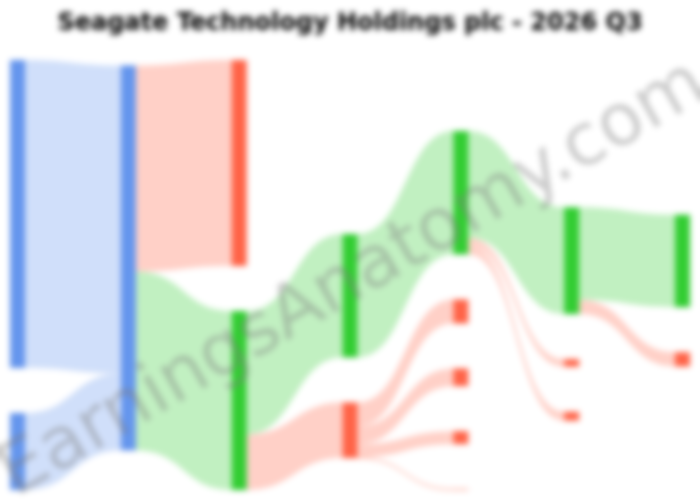
The most striking takeaway from the latest quarter is the robust growth in both sales and profitability. The company shipped an impressive 199.4 exabytes of HDD storage, with high-capacity "Nearline" drives, typically used in data centers, making up 175.4 exabytes of that total. This demand propelled total revenue to $3.11 billion, a massive 44% increase compared to the $2.16 billion reported in the same quarter last year. The Data Center market was the undisputed engine here, accounting for 80% of total revenue.
But it isn't just about selling more drives; it’s about selling them more profitably. Cost of revenue was $1.67 billion, resulting in a gross profit of $1.45 billion. Thanks to what the company describes as "pricing actions," Seagate's gross margin expanded dramatically to 46%, up from 35% a year prior.
On the operational front, Seagate managed its core costs effectively while absorbing a notable one-time expense. Product development expenses were $194 million, and marketing and administrative costs came in at $143 million, both remaining relatively stable as a percentage of revenue.
However, operating expenses also included a significant new $105 million legal settlement charge, which appeared on the income statement this quarter. Despite this charge and an additional $7 million in restructuring costs, operating income more than doubled year-over-year to $998 million, showcasing impressive underlying operational leverage.
Below the operating line, Seagate recorded $134 million in net other expenses. A key component of this was a $69 million net loss from debt transactions. This reflects the company's active management of its capital structure. Over the first nine months of its fiscal year, Seagate used $1.1 billion in cash for the redemption and repurchase of debt, signaling a clear focus on deleveraging.
After factoring in a $116 million provision for income taxes, Seagate’s net income landed at a robust $748 million, or $3.27 per diluted share. This is a massive leap from the $340 million, or $1.57 per share, generated in the prior-year quarter.
Seagate’s third-quarter results illustrate a company successfully capitalizing on the immense demand for mass-capacity data storage. As the world generates unprecedented amounts of data, cloud and enterprise customers are driving a need for cost-effective storage solutions. While navigating a significant legal settlement and actively managing its debt load, Seagate's strong pricing power and margin expansion prove that the data storage industry remains fundamentally strong. This quarter's performance positions the company well to continue building on the structural growth trends shaping the digital landscape.
Last updated: April 30, 2026