Loading blog posts...
October 23, 2026 • 3 min read
Digging into the income statement from Ryder System’s latest 10-Q filing offers a clear look at how the transportation and logistics powerhouse is performing in an evolving freight cycle. While freight market conditions have presented headwinds across the logistics industry, examining Ryder’s revenue composition and cost discipline reveals how its balanced business model is driving earnings expansion.
Ryder operates across three primary business divisions: Fleet Management Solutions (FMS), which provides full-service vehicle leasing (ChoiceLease), commercial rental, and maintenance; Supply Chain Solutions (SCS), delivering end-to-end warehousing, logistics, and distribution; and Dedicated Transportation Solutions (DTS), which supplies tailored fleets, professional drivers, and fleet management.
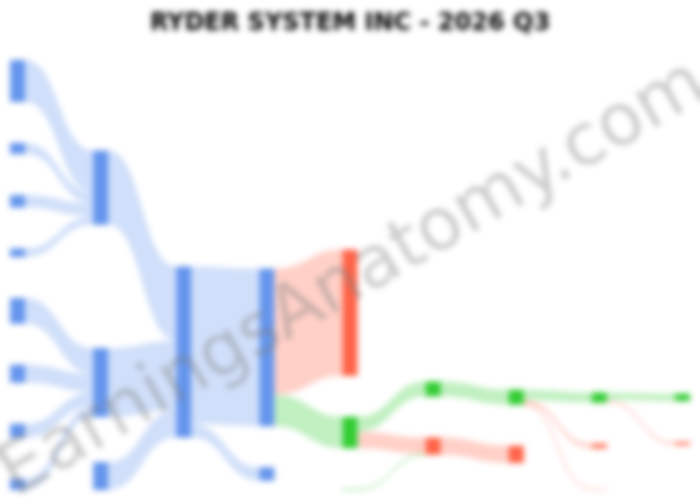
Here is a visual breakdown of how Ryder transformed its top-line revenue into net income during the third quarter of 2026:
The top-line total of $3.43 billion reflects an 8% increase compared to $3.17 billion in the third quarter of 2025. In the flow above, gross segment revenues sum to over $3.72 billion before being offset by $293 million in intersegment eliminations. These eliminations primarily account for internal vehicle leases and maintenance services provided by FMS to the dedicated fleet operations of DTS and SCS.
Ryder generated $685 million in gross profit on $2.75 billion in operating costs, representing a solid 20% gross margin. Operating income climbed to $327 million, boosted by improved pricing and utilization in commercial rental alongside higher recoveries in used vehicle sales.
Used vehicle sales, net, yielded a net gain of $17 million for the quarter—a notable jump from $3 million in the prior-year period. Average sales proceeds per unit increased 19% for tractors and 5% for trucks on a constant-currency basis, while revenue earning equipment held for sale declined to 7,300 units from 9,500 at year-end 2025. Simultaneously, commercial rental power fleet utilization rose 700 basis points year-over-year to 77%, demonstrating active fleet right-sizing.
Consequently, pre-tax earnings in the FMS segment surged 21% to $177 million.
In Supply Chain Solutions, total revenue rose 9% to $1.50 billion, propelled by a 26% jump in omnichannel retail logistics ($404 million). Segment pre-tax earnings reached $91 million, up 7% year-over-year. Dedicated Transportation Solutions (DTS) saw revenue rise 6% to $606 million, though segment pre-tax earnings dipped slightly from $36 million to $34 million amid inflationary driver wage and subcontracted transportation costs.
On the bottom line, Ryder delivered net earnings from continuing operations of $162 million, or $4.16 per diluted share, representing a 25% increase over Q3 2025 diluted EPS of $3.33. Share repurchases—retiring roughly 1.7 million shares year-to-date—also provided an accretive tailwind to per-share results.
Cash conversion was another bright spot. For the first nine months of 2026, Ryder generated $1.99 billion in operating cash flow from continuing operations, while capital expenditures moderated to $1.38 billion, driving free cash flow to $992 million—double the $496 million generated during the same period in 2025.
Ryder continues to navigate persistent freight cycle volatility, changing customer shipping volumes, and competitive pressure from rivals such as Penske Truck Leasing in fleet management and J.B. Hunt in dedicated contract transport. Nevertheless, by focusing on long-term contractual ChoiceLease agreements, disciplined capital allocation, and higher-margin supply chain contracts, Ryder continues to insulate its balance sheet and demonstrate steady operational resilience.
Last updated: October 23, 2026
Explore prior quarterly filings, historical revenue breakdowns, and earnings trends.
Visual breakdowns and margin trends from recent public company SEC filings.