Loading blog posts...
July 31, 2026 • 4 min read
Robinhood's second quarter of 2026 was its biggest ever by revenue — but the composition of that revenue looks meaningfully different than it did a year ago. Prediction markets have overtaken crypto, margin lending has overtaken payment-for-order-flow tailwinds as the interest engine, and a one-time gain from spinning off its venture fund flatters the bottom line. Let's dig into the Q2 10-Q to see what the income statement actually says about how the business is evolving.
Robinhood, for the uninitiated, is the commission-free brokerage that popularized zero-fee retail trading. It monetizes primarily through payment for order flow (PFOF) — rebates paid by market makers such as Citadel Securities for routing customer orders — plus interest on customer margin loans and cash, and subscription fees for Robinhood Gold. It competes with Charles Schwab, Interactive Brokers, Coinbase and, increasingly, prediction-market venues like Kalshi and Polymarket.
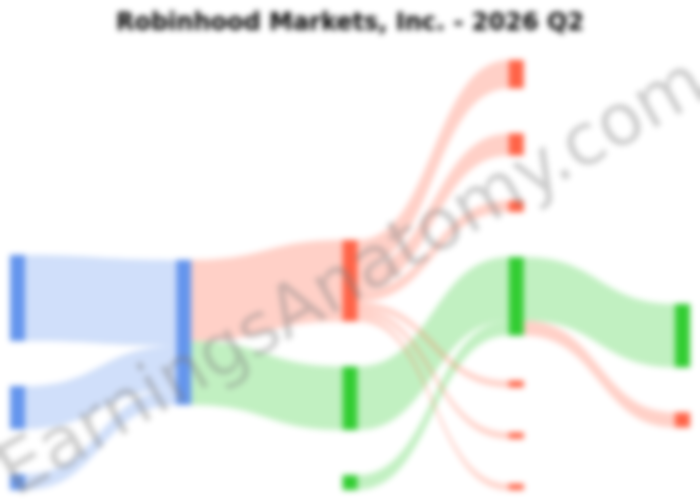
Total net revenues rose 32% to $1.31 billion, with net income of $573 million and diluted EPS of $0.62, up from $0.42.
The transaction line ($776 million, +44%) tells the story:
For the first time, prediction markets out-earned crypto. That's a notable diversification win — but it also swaps one volatile, regulator-contested revenue stream for another. The filing details ongoing event-contract litigation with state regulators in Massachusetts, Michigan and elsewhere.
Net interest revenues rose only 9% to $389 million, and the internals are more interesting than the headline. Margin interest nearly doubled to $215 million as the average margin book ballooned to $19.0 billion from $8.9 billion. Credit card interest tripled to $40 million.
Offsetting that, every rate-sensitive line shrank: cash sweep fell 32%, interest on corporate cash fell 33%, and securities lending collapsed 81% to $10 million — Robinhood earned $112 million lending securities but paid out $102 million. Robinhood also began paying users $57 million in interest on uninvested cash, versus zero a year ago. The blended net interest yield fell to 2.34% from 2.78%. The company estimates a 100-basis-point rate move would swing revenue by $350 million annually — a large, uncontrollable lever.
The $135 million of "other income" is almost entirely non-recurring: a $106 million gain on deconsolidating Robinhood Ventures Fund I (RVI) — the closed-end fund Robinhood IPO'd in March 2026 to give retail investors exposure to private companies like OpenAI, Anthropic, Stripe and Databricks — plus $23 million of gains on equity securities. Strip those out and pretax income is $574 million, not $709 million. Adjusted EBITDA of $741 million (+35%) excludes them.
Meanwhile the effective tax rate jumped to 19.2% from 12.7% as excess tax benefits from share-based compensation faded. And the provision for credit losses doubled to $56 million, driven by the credit card book, which grew 40% to $1.46 billion with past-due loans ticking up to 6% from 5%.
Operating margin held roughly flat at 44%, and marketing spend rose just 5% while funded customers reached 28.4 million and ARPU climbed 24% to $187 — evidence that growth is getting cheaper. Robinhood also cut about 10% of staff in June ($23 million in restructuring charges) and raised $2.2 billion in 0.00% convertible notes due 2029, its first major debt.
The challenge ahead is durability. Options and event contracts now supply 38% of revenue, market makers account for 47% of net revenues (Citadel alone 16%), and falling rates squeeze the interest book. Robinhood has proven it can invent new revenue lines faster than old ones fade — the question is whether regulators, competitors like Kalshi and Coinbase, and the rate cycle let it keep doing so.
Last updated: July 31, 2026
Explore prior quarterly filings, historical revenue breakdowns, and earnings trends.
Visual breakdowns and margin trends from recent public company SEC filings.