Loading blog posts...
August 21, 2026 • 3 min read
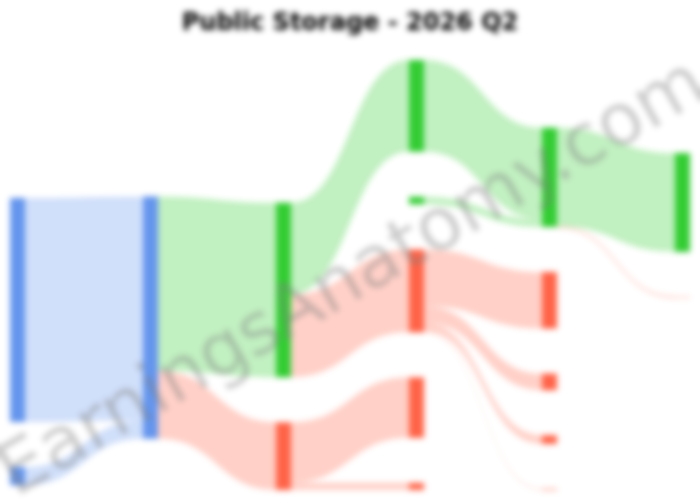
Examining the financial performance of self-storage real estate investment trusts (REITs) provides valuable insight into broader consumer trends, moving patterns, and housing mobility. Digging into the income statement from Public Storage’s latest 10-Q filing allows us to look beneath top-line performance, evaluate how underlying customer demand is shifting, and assess how the company is managing operating cost pressures as it integrates major portfolio additions.
For the second quarter ended June 30, 2026, Public Storage generated $1.23 billion in total revenue, representing a 2.6% increase compared to $1.20 billion in the second quarter of 2025.
The company’s core self-storage facilities generated $1.14 billion (92.5% of total revenue) with direct operational costs of $307.8 million. Ancillary operations—consisting of tenant reinsurance, merchandise sales, and third-party property management—added $92.9 million in revenue against $36.3 million in operating expenses.
Total operating expenses also included $287.8 million in depreciation and amortization, $44.4 million in general and administrative (G&A) overhead, $84.8 million in interest expense, and $5.2 million in real estate acquisition and development costs. Bringing total expenses to $766.2 million, Public Storage delivered $466.7 million in operating income for the quarter.
While newly acquired and developed facilities expanded total revenue, the same-store portfolio (2,755 facilities owned and operated continuously since January 2024) experienced slight compression:
Underlying move-in dynamics illustrate the current pricing environment across the portfolio. Customers moving in during the quarter paid an average annual contract rent of $13.49 per square foot, while vacating customers departed with an average rate of $19.34 per square foot. Although period-end same-store occupancy improved slightly from 91.9% to 92.4%, the promotional discounts and rate spread between incoming and departing tenants continue to weigh on organic revenue growth.
Net income rose 39.2% year-over-year to $502.9 million ($2.55 per diluted share), compared to $361.4 million in Q2 2025. This sharp increase was heavily influenced by foreign currency fluctuations on Euro-denominated debt: the company recorded a $17.2 million foreign currency exchange gain in Q2 2026 compared to a steep $(146.1) million FX loss in Q2 2025.
Because GAAP net income includes non-cash real estate depreciation and non-operational FX swings, REIT investors rely on Funds From Operations (FFO) and Core FFO:
Shortly after quarter-end, on July 22, 2026, Public Storage closed its all-stock merger with National Storage Affiliates Trust (NSA). While this transaction adds significant facility count and expands operating scale, the filing highlights key execution risks, including the complexities of consolidating management systems, integrating internal controls, and achieving anticipated operational synergies. Moving into the second half of 2026, managing these integration demands while stabilizing move-in rental rates will be central to supporting same-store NOI recovery.
Last updated: August 21, 2026
Visual breakdowns and margin trends from recent public company SEC filings.
Norwegian Cruise Line Q3 2026: Higher Net Income Masks Weaker Operations
Oct 30, 2026
Read
Citizens Financial Group (CFG) Q3 2026: NII Expansion & Margin Growth
Oct 30, 2026
Read
Chubb Limited Q3 2026 10-Q Analysis: 84.1% Combined Ratio & $1.79B Investment Income
Oct 30, 2026
Read
MGM Resorts Q3 2026: Operating Profit Rebounds as Adjusted EBITDA Falls 20.4%
Oct 30, 2026
Read