Loading blog posts...
August 5, 2026 • 4 min read
When you walk down the aisles of almost any supermarket or pharmacy in the world, you are bound to pass dozens of products made by consumer goods titan Procter & Gamble (P&G). From Tide laundry detergent and Pampers diapers to Gillette razors and Crest toothpaste, P&G's portfolio is deeply embedded in the daily routines of billions of consumers. Today, our goal is to dig into the income statement from their latest 10-K filing for the fiscal year ended June 30, 2026, to see how the company is navigating the current economic environment and what we can learn from their financial performance.
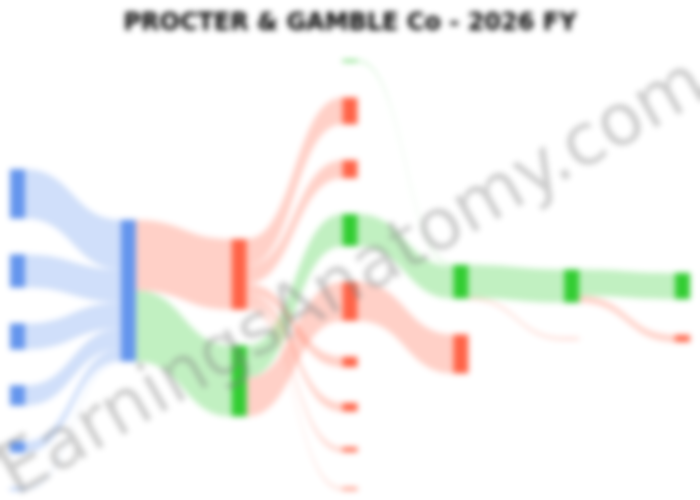
P&G wrapped up its 2026 fiscal year with $87.0 billion in total revenue, marking a steady 3% increase from 2025. But where did this growth actually come from? Interestingly, it wasn't from selling more units. The company reported that overall unit volume was completely flat year-over-year. Instead, the revenue bump was driven entirely by favorable foreign exchange rates (contributing 2% to growth) and strategic price hikes (contributing 1%).
Despite bringing in more revenue, P&G actually saw its operating profit shrink. Operating income dropped 3% to $19.7 billion. This compression was the result of lower operating margins, which fell by 160 basis points (or 1.6 percentage points) to 22.7%.
A major culprit for this squeeze was an increase in Selling, General and Administrative (SG&A) expenses—the costs associated with corporate overhead, marketing, and running the day-to-day business. SG&A rose 6% to $23.9 billion. P&G noted that this was heavily driven by increased marketing spend as a percentage of net sales, alongside higher restructuring costs and wage inflation, though these were partially offset by internal productivity savings.
Ultimately, P&G still managed to keep its bottom line remarkably stable. Net income clocked in at $16.1 billion (a 19% net margin), practically flat compared to the $16.0 billion generated in 2025.
P&G’s operations are divided into five massive sector business units, each catering to different aspects of consumer care:
P&G’s filing doesn't shy away from the challenges on the horizon. The company explicitly calls out the ongoing risks of macroeconomic volatility, shifting geopolitical conditions, and global supply chain disruptions. Furthermore, international trade policies continue to be a thorn in the side of global manufacturers; P&G reported a 30 basis point hit to their gross margins specifically stemming from higher U.S. tariffs.
Even with margins under pressure, P&G remains a formidable cash-generating machine. The company produced a massive $19.6 billion in operating cash flow in 2026. True to its reputation as a reliable blue-chip stock, P&G returned the vast majority of that cash directly to shareholders, paying out $10.2 billion in dividends and spending $5.0 billion on share repurchases.
Looking ahead, P&G’s primary challenge will be balancing its pricing power. As everyday consumers continue to navigate economic uncertainties, P&G will have to carefully manage its pricing and marketing strategies to defend its market share against cheaper, private-label store brands without sacrificing its profitability.
Last updated: August 5, 2026
Explore prior quarterly filings, historical revenue breakdowns, and earnings trends.
Procter & Gamble Q1 FY2027: Sales Rise 4% as Higher Costs Squeeze Margins
Oct 22, 2026
Read
P&G Q3 2026 Earnings Analysis: Sales Growth and Margin Pressures
Apr 25, 2026
Read
Procter & Gamble Q2 Earnings: Rising Costs Squeeze Margins
Jan 24, 2026
Read
P&G's Q1 2026 10-Q: The Story Behind a 20% Earnings Jump
Oct 25, 2025
Read