Loading blog posts...
January 24, 2026 • 4 min read
Procter & Gamble (P&G) is often viewed as a global economic bellwether. As the titan behind ubiquitous household names like Tide, Pampers, and Gillette, its financial health offers a glimpse into the state of the consumer wallet. In their latest 10-Q filing for the quarter ended December 31, 2025, P&G revealed a mixed picture: while top-line sales managed to inch upward, the company faced significant pressure on its profitability due to rising costs and restructuring efforts.
Let’s dig into the income statement to see exactly where the money is coming from and where it is going.
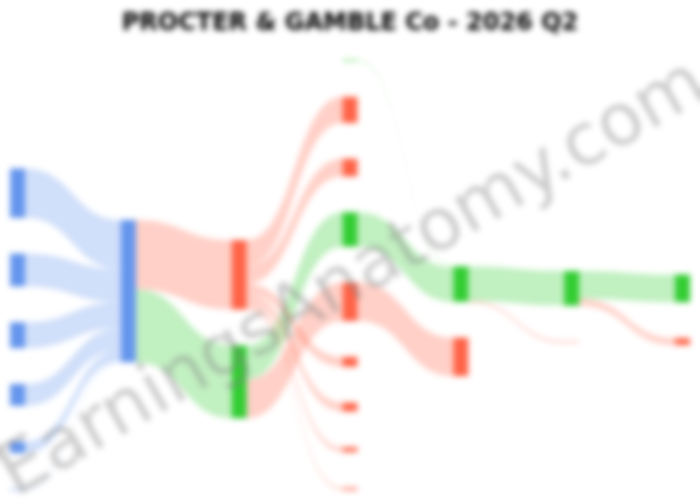
Note: In the visualization above, you will notice a "Revenue not allocated to divisions" item of $160 million. This represents "Corporate" net sales, which generally includes adjustments or incidental revenue not directly tied to P&G's five primary business sectors.
For the quarter, P&G reported Net Sales of $22.2 billion, a modest 1% increase compared to the same period last year. This growth was driven primarily by higher pricing and favorable foreign exchange impacts, which helped offset a 1% decline in shipment volume. Essentially, P&G sold slightly fewer items but charged more for them (or benefited from currency conversion).
However, the real story lies further down the income statement. Net Earnings fell 7% to $4.3 billion, and Diluted Earnings Per Share (EPS) dropped 5% to $1.78.
What caused this profit squeeze? The filing highlights a few specific headwinds that eroded Gross Margin (the difference between sales and the cost of goods sold) by 120 basis points to 51.2%:
While manufacturing productivity savings helped offset some of these issues, it wasn't enough to prevent a slide in operating income.
P&G operates through five main segments, and their performance was divergent this quarter.
Financial filings often contain "Non-GAAP" measures, which are adjusted figures that companies believe better reflect their ongoing business performance. P&G emphasized its "Core EPS," which excludes the impact of the restructuring charges mentioned earlier.
While GAAP EPS fell to $1.78, Core EPS held steady at $1.88, flat compared to the prior year. This suggests that without the one-time costs of reorganizing the business, P&G's profitability would have remained stable.
This quarter highlights the defensive nature of Procter & Gamble, but also the challenges of growing a giant in a constrained economic environment. While the company continues to return massive amounts of cash to shareholders—$2.5 billion in dividends and $2.3 billion in share repurchases this quarter alone—it is fighting against volume declines and rising input costs.
As P&G navigates these headwinds, it faces stiff competition from rivals like Unilever and Kimberly-Clark, as well as retailer-owned private labels. The company’s ability to innovate in its high-margin Beauty and Health Care segments while managing costs in its commodity-sensitive Family Care business will be crucial for the quarters ahead.
Last updated: January 24, 2026
Visual breakdowns and margin trends from recent public company SEC filings.
Norwegian Cruise Line Q3 2026: Higher Net Income Masks Weaker Operations
Oct 30, 2026
Read
Citizens Financial Group (CFG) Q3 2026: NII Expansion & Margin Growth
Oct 30, 2026
Read
Chubb Limited Q3 2026 10-Q Analysis: 84.1% Combined Ratio & $1.79B Investment Income
Oct 30, 2026
Read
MGM Resorts Q3 2026: Operating Profit Rebounds as Adjusted EBITDA Falls 20.4%
Oct 30, 2026
Read