Loading blog posts...
October 22, 2026 • 3 min read
PG&E’s third-quarter income statement shows why falling earnings do not always mean weaker operations. Digging into the company’s September 2026 10-Q reveals higher operating profit despite slightly lower revenue—but a smaller tax benefit pulled net income down. For the parent of Pacific Gas and Electric Company, which supplies electricity and natural gas across Northern and Central California, financing costs and regulatory recovery remain central to understanding profitability.
Quarterly revenue fell 1% to $6.19 billion. Electricity contributed $4.66 billion, down 2%, while natural gas revenue rose 2% to $1.53 billion.
Yet consolidated operating income increased 3.3% to $1.25 billion, lifting operating margin from 19.3% to 20.2%. The main movements were:
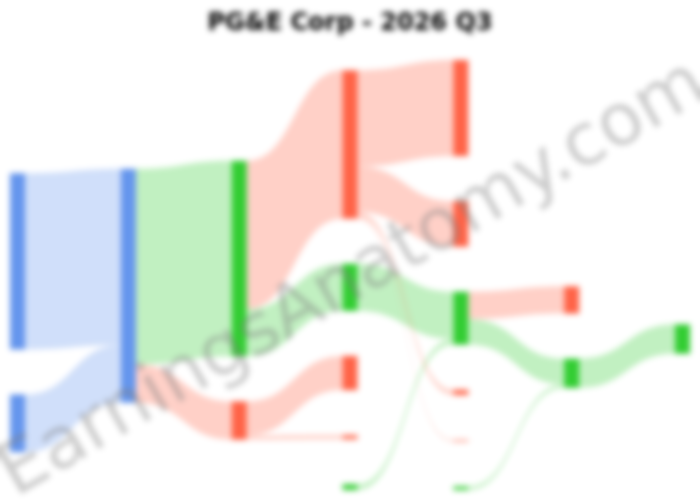
The quarterly revenue-to-profit flow illustrates these competing pressures:
The diagram’s 83.6% gross margin needs context: it subtracts only electricity and gas procurement costs. Maintaining infrastructure, depreciation and other substantial utility expenses come afterward. It is therefore not a measure of the profitability of delivering energy.
Revenue also reflects regulatory accounting, not simply customer demand. Gas revenue from customer contracts declined $33 million, but a $66 million increase in regulatory balancing-account revenue more than offset that decline. These accounts recognize amounts authorized for future billing or refunds, helping explain why reported revenue can move differently from customer sales.
Pretax income rose 8% to $681 million, but net income fell from $850 million to $776 million.
The explanation is straightforward: PG&E’s income tax benefit shrank from $220 million to $95 million. That $125 million reduction outweighed the $51 million improvement in pretax earnings.
After $27 million in preferred dividend requirements, income available to common shareholders was $749 million, down 9%. Basic and diluted earnings per share both declined to $0.34 from $0.37.
Financing remains a substantial constraint. Interest expense reached $825 million, up $55 million. After interest income, the net interest burden was $721 million—equivalent to approximately 58% of operating income.
The nine-month picture was stronger: revenue increased 4.6% to $18.97 billion, operating income rose 13% to $3.98 billion, and common-shareholder income increased 20% to $2.34 billion.
Earnings growth has not eliminated PG&E’s funding needs. Consolidated operating cash flow for the first nine months declined 14% to $5.84 billion, while capital expenditures increased 11% to $9.62 billion. That left a $3.78 billion gap before dividends and other investing activity.
Safety investment remains prominent. The filing records a September submission of a 2028–2037 undergrounding plan. In its October 1 announcement, PG&E said undergrounding costs per mile had fallen approximately 25% over recent years.
The takeaway: operating performance improved, while taxes weakened quarterly earnings and investment continued to exceed internally generated cash. For this regulated utility, the key challenge is balancing safety and reliability spending with financing costs and customer affordability. A proposed $456 million in interim rate recovery for 2027 underscores how consequential regulatory decisions remain; it was not yet final in this filing.
Last updated: October 22, 2026
Visual breakdowns and margin trends from recent public company SEC filings.
Norwegian Cruise Line Q3 2026: Higher Net Income Masks Weaker Operations
Oct 30, 2026
Read
Citizens Financial Group (CFG) Q3 2026: NII Expansion & Margin Growth
Oct 30, 2026
Read
Chubb Limited Q3 2026 10-Q Analysis: 84.1% Combined Ratio & $1.79B Investment Income
Oct 30, 2026
Read
MGM Resorts Q3 2026: Operating Profit Rebounds as Adjusted EBITDA Falls 20.4%
Oct 30, 2026
Read