Loading blog posts...
August 26, 2026 • 3 min read
NVIDIA’s accelerated computing momentum continues to reach unprecedented scale. To understand what is driving this rapid expansion and what the financial details reveal about the company's trajectory, we want to dig into the income statement from NVIDIA’s latest 10-Q filing for the second quarter of fiscal 2027 (ended July 26, 2026). By examining top-line revenue sources, operating expenses, and underlying balance sheet commitments, we can see how effectively NVIDIA translates global demand for AI infrastructure into bottom-line profits.
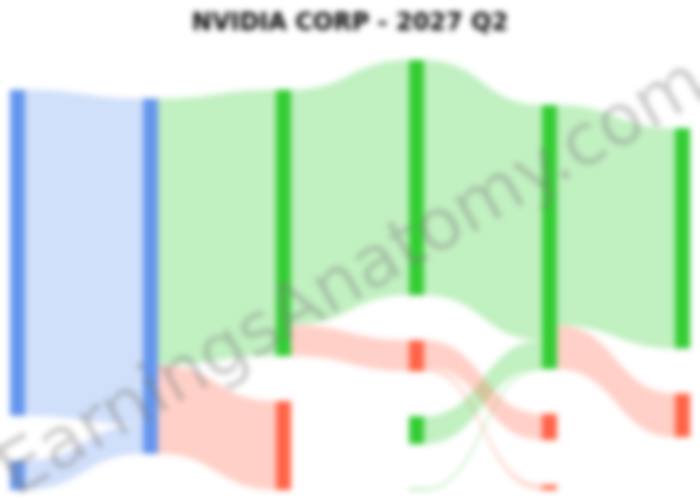
NVIDIA delivered total quarterly revenue of $96.2 billion, representing a 106% year-over-year surge from $46.7 billion in the same quarter last year, as well as an 18% sequential increase from the prior quarter.
The revenue expansion was concentrated in the Compute & Networking reportable segment, which includes data center compute platforms and networking architectures. Revenue in this segment climbed 114% year-over-year to $88.3 billion (accounting for nearly 92% of total revenue), propelled by the ramp of Blackwell Ultra infrastructure. The Graphics segment—encompassing GeForce GPUs for gaming and PCs as well as Quadro and NVIDIA RTX GPUs for enterprise workstation graphics—grew 46% year-over-year to $7.9 billion, supported by sales of Blackwell architecture products.
Looking across market platforms, Data Center brought in $89.0 billion (up 117% YoY), split between Hyperscale customers ($48.7 billion) and AI Clouds, Industrial, & Enterprise ($40.3 billion), while Edge Computing added $7.2 billion. Gross profit reached $72.1 billion, reflecting a 75.0% gross margin compared to 72.4% a year ago, driven by improved mix from Blackwell Ultra.
NVIDIA converted its top-line gains into substantial profit through strong operating leverage—expanding revenue at a much faster rate than operating costs:
Below the operating line, NVIDIA recorded $7.77 billion in net gains from equity securities, included within other income, net ($7.773 billion total). This helped lift pre-tax income to $71.5 billion. After accounting for $11.8 billion in income tax expense, NVIDIA posted quarterly net income of $59.7 billion (a 62.0% net margin) and diluted earnings per share (EPS) of $2.46, up 128% from $1.08 a year ago.
NVIDIA paired its operating cash flow with substantial capital return and liquidity management. During the quarter, the company repurchased 94 million shares of common stock for $19.7 billion and paid cash dividends of $0.25 per share ($6.0 billion total). In June 2026, NVIDIA also bolstered liquidity by issuing $25.0 billion in senior unsecured notes across seven tranches.
To secure future manufacturing and data center capacity, NVIDIA held $279 billion in supply and capacity purchase commitments extending through fiscal 2032 and thereafter, alongside $3.5 billion in land, power, and shell guarantees for AI clouds and an additional $105.0 billion guarantee entered into with SB Energy Corp. in August 2026.
Moving forward, NVIDIA must manage complex operational and regulatory headwinds, including evolving worldwide export control restrictions on advanced computing hardware. However, this quarter's financial performance highlights the immense commercial scale of NVIDIA's full-stack computing ecosystem as data centers continue their transition to accelerated infrastructure.
Last updated: August 26, 2026
Explore prior quarterly filings, historical revenue breakdowns, and earnings trends.
Unpacking Nvidia's Q1 FY27 10-Q: $81.6B Revenue and the AI Economy
May 20, 2026
Read
NVIDIA FY2026 10-K Analysis: The Financial Mechanics of the AI Boom
Feb 26, 2026
Read
NVIDIA Q3 FY26 Results: AI Dominance Drives $57B Revenue Amid Geographic Shifts
Nov 20, 2025
Read
NVIDIA Q2 FY2026 Earnings: AI Boom Fuels Record $46.7B Revenue
Aug 27, 2025
Read