Loading blog posts...
July 28, 2026 • 4 min read
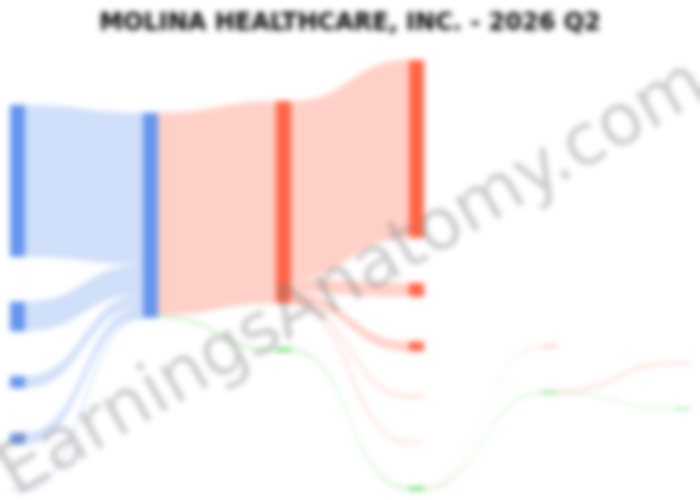
When a healthcare giant's net income drops 76% year-over-year, it naturally invites scrutiny. The goal today is to dig into the income statement from Molina Healthcare's latest 10-Q filing to see exactly how things are going and what insights can be drawn from their second quarter of 2026.
For the unfamiliar, Molina is a Fortune 500 managed care company that provides health insurance through government programs—primarily Medicaid and Medicare—as well as the state insurance marketplaces (often referred to as the Affordable Care Act or ACA exchanges). While they compete with massive players like Centene and UnitedHealth Group, Molina has historically carved out a strong niche in managing complex, government-sponsored populations.
For the quarter ending June 30, 2026, Molina reported total revenue of roughly $10.9 billion, a modest 5% decline from the $11.4 billion reported in Q2 2025. However, the real shift happened further down the income statement. Net income plunged to just $60.0 million (resulting in a razor-thin 0.5% net margin), compared to $255.0 million in the same period last year.
Looking at the flow of money, one thing that stands out on the revenue side is the $606.0 million in unallocated revenue. Rather than belonging to a specific health plan segment like Medicare or Medicaid, this bucket catches corporate-level inflows. Specifically, it consists of premium tax revenue, investment income ($101.0 million for the quarter), and certain other operating revenues that are not directly tied to the core underwriting of the medical segments.
To understand why profits shrank so dramatically despite generating nearly $11 billion in total revenue, attention must turn to the Medical Care Ratio (MCR). Also known as the Medical Loss Ratio, MCR is a critical health insurance industry metric that measures the percentage of premium revenue consumed by actual medical care costs. A higher MCR means less money is left over to cover administrative expenses and generate profit.
In Q2 2026, Molina's consolidated MCR jumped to 92.2%, up from 90.4% a year ago. Out of $10.2 billion in pure premium revenue, a staggering $9.4 billion went straight out the door to cover medical care costs. The company, much like its peers, is actively navigating a challenging medical cost environment driven by higher utilization rates and shifting patient risk pools.
Molina's core business is split into three main segments, and the current financial pressures are not evenly distributed:
The filing and recent company developments reveal that Molina has actively reduced its Marketplace membership—dropping from roughly 690,000 members a year ago to just 283,000 at the end of Q2 2026. By raising rates significantly to contain rising costs and combat adverse selection (where sicker, more expensive patients disproportionately enroll), the company is deliberately shrinking this segment to protect future margins.
Molina Healthcare's Q2 2026 results paint a picture of a company actively playing defense. The sharp drop in net income and the intentional shrinking of their ACA Marketplace footprint highlight the intense cost pressures facing government-sponsored health insurers right now. Management has recently signaled to the market that they believe 2026 represents a "trough year" for Medicaid margins, banking on future rate increases from state governments to restore historical profitability. Whether Molina can successfully reset its risk pool and bounce back in 2027 remains the multi-billion-dollar question for investors and the managed care market at large.
Last updated: July 28, 2026
Visual breakdowns and margin trends from recent public company SEC filings.
Norwegian Cruise Line Q3 2026: Higher Net Income Masks Weaker Operations
Oct 30, 2026
Read
Citizens Financial Group (CFG) Q3 2026: NII Expansion & Margin Growth
Oct 30, 2026
Read
Chubb Limited Q3 2026 10-Q Analysis: 84.1% Combined Ratio & $1.79B Investment Income
Oct 30, 2026
Read
MGM Resorts Q3 2026: Operating Profit Rebounds as Adjusted EBITDA Falls 20.4%
Oct 30, 2026
Read