Loading blog posts...
April 24, 2026 • 3 min read
When a Fortune 500 managed care giant reports a 95% drop in quarterly net income, Wall Street immediately pays attention. Let's unpack the numbers from Molina Healthcare's latest 10-Q filing to see exactly what is driving this steep decline and what it tells us about the company's underlying health.
For those unfamiliar, Molina Healthcare (NYSE: MOH) is a major player in government-sponsored healthcare. They provide health insurance primarily through Medicaid, Medicare, and the ACA Marketplace, competing with heavyweights like Centene, Elevance Health, and UnitedHealth Group. Their first-quarter 2026 results reveal a company navigating a tough industry landscape by making some hard, expensive choices.
The most immediate cause of the nosedive in profits—from $298 million in Q1 2025 down to just $14 million in Q1 2026—is a massive $93 million impairment charge. In simple terms, an impairment charge means a company has to write down the value of an asset on its balance sheet because it is no longer expected to generate the previously anticipated level of future income.
According to the filing, this specific charge is tied to Molina's strategic decision to exit its MAPD (Medicare Advantage Prescription Drug) product line in 2027. While this charge single-handedly erased a large chunk of pre-tax income, it represents a deliberate business move to shed an underperforming segment. However, this one-time event isn't the only reason for the dramatic drop in profitability.
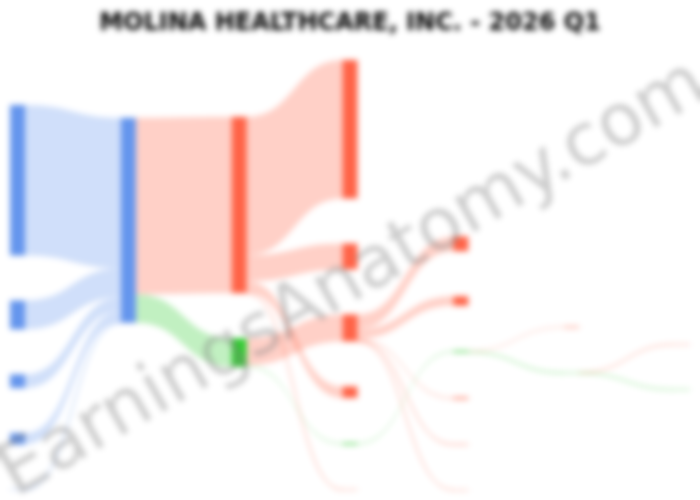
Even without the impairment, Molina's pre-tax income would have been significantly lower than the same period last year. A closer look reveals pressure on the company's core business performance. The flow diagram below visualizes how the company’s $10.8 billion in quarterly revenue is allocated to different costs and expenses, ultimately trickling down to that slim $14 million in net income.
A key metric to watch for any health insurer is the Medical Care Ratio (MCR), which measures how much of every premium dollar is spent directly on medical claims. A higher MCR means lower profitability. In the first quarter of 2026, Molina’s consolidated MCR climbed to 91.1%, up from 89.2% in Q1 2025.
While a 1.9 percentage point increase may seem small, for a company handling over $10 billion in quarterly premiums, it has a massive impact. This increase contributed to the company's "medical margin"—the profit left over after paying medical costs—shrinking from $1.15 billion in Q1 2025 to $902 million this quarter. The filing also notes that the impact of prior-year reserve development in Q1 2026 was mostly absorbed by minimum Medical Loss Ratios (MLRs) and medical cost corridors, highlighting the complex regulatory guardrails these companies operate within.
Molina Healthcare's first-quarter results paint a picture of a company at a crossroads. The 95% plunge in net income is the result of two distinct factors: a significant one-time charge from a strategic business exit and, more fundamentally, deteriorating core profitability driven by a higher Medical Care Ratio.
The decision to exit the MAPD product shows management is willing to make tough calls to streamline operations. Still, the rising MCR highlights the persistent challenge managed care organizations face in balancing government-set premium rates with the unpredictable cost of healthcare utilization. As the year progresses, the market will be watching closely to see if Molina can rein in its medical costs and stabilize its core margins.
Last updated: April 24, 2026
Explore prior quarterly filings, historical revenue breakdowns, and earnings trends.
Molina Healthcare Q3 2026: Profit Falls 52% as Medicaid Margins Weaken
Oct 22, 2026
Read
Molina Healthcare Q2 2026: Decoding the 76% Net Income Drop
Jul 28, 2026
Read
Molina Healthcare 2025: Revenue Grows but Rising MCR Crushes Margins
Apr 6, 2026
Read
Molina Healthcare Q3 2025: Rising Medical Costs Squeeze Profits Despite Revenue Growth
Oct 27, 2025
Read