Loading blog posts...
October 22, 2026 • 3 min read
Molina Healthcare’s third-quarter income statement shows how a modest revenue decline can produce a much larger earnings hit when insurance margins are thin. A closer look at its September 2026 10-Q helps explain where profitability is weakening—and where it is improving. Molina, which provides government-sponsored health coverage to approximately 4.9 million members across 21 states, reported $11.1 billion in revenue but retained just $38 million in net income.
Total revenue fell 3.4% year over year, while operating income declined 23% to $106 million. Net income dropped 52% from $79 million, and diluted earnings per share fell from $1.51 to $0.73.
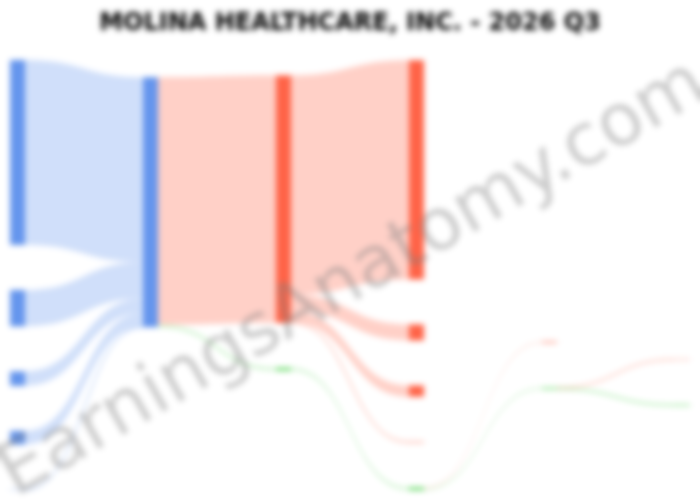
The quarterly revenue-to-profit flow illustrates that narrow earnings cushion:
The $602 million of revenue outside the segments consists of $500 million in premium tax revenue and $102 million in investment income. Premium tax revenue has an equal expense, so it increases reported revenue without adding profit.
The central operating measure is the medical care ratio (MCR)—medical costs divided by insurance premium revenue. It rose from 92.6% to 92.9%, leaving $738 million after medical costs, versus $797 million a year earlier, to help cover administration and other expenses.
General and administrative costs declined to $710 million from $729 million, but remained 6.4% of total revenue. Those savings could not fully offset the weaker medical margin. Interest expense then consumed half of operating income, and the effective tax rate rose from 10.1% to 28.5%, further reducing earnings.
The segment results reveal two different challenges:
These medical margins are before administrative and other corporate expenses, not segment operating profits.
The distinction matters: Marketplace’s contraction drove the revenue decline, but Medicaid’s deteriorating medical-cost economics were the larger quarterly margin problem. Medicaid now represents roughly 78% of premium revenue, making its performance especially consequential.
For the first nine months, net income fell 82% to $112 million, while operating income declined from $943 million to $334 million. Results included a $93 million impairment charge, with none recorded in the third quarter.
Medical costs also benefited from $352 million in favorable prior-year claims development—earlier claims estimates proving higher than subsequently indicated—versus $124 million a year earlier. That benefit was partly absorbed by contractual mechanisms limiting insurer returns.
Operating cash flow improved to $629 million, from a $237 million outflow, supported partly by working-capital movements and noncash adjustments.
The takeaway is that shrinking enrollment alone does not explain Molina’s earnings decline. In the government-focused insurance market shared with competitors such as Centene and UnitedHealthcare, maintaining adequate premiums relative to medical costs remains critical. Molina’s improved Marketplace ratio is encouraging, but its much larger Medicaid business remains the key profitability pressure point.
Last updated: October 22, 2026