Loading blog posts...
January 28, 2026 • 4 min read
Microsoft’s dominance in the technology sector continues to be a central theme for investors, but their latest financial results offer a fascinating look at how artificial intelligence is reshaping not just their products, but their balance sheet. By digging into the numbers from their latest 10-Q filing for the quarter ended December 31, 2025, we can separate the company's operational strength from significant one-time financial events.
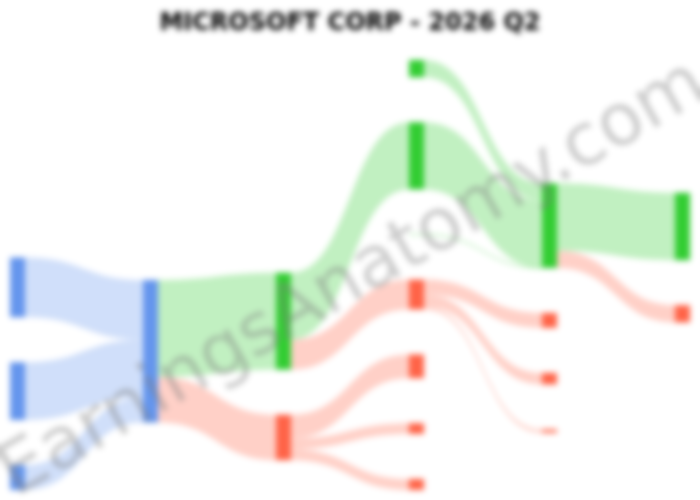
To visualize how money flows through this massive organization, the diagram below breaks down the quarterly revenue sources against expenses, filtering down to the final net income figure:
The headline numbers are staggering, but they require context. Microsoft reported a net income of $38.5 billion, a massive 60% increase year-over-year. However, a significant portion of this growth didn't come from selling software or cloud services.
Buried in the "Other income (expense), net" line item is a gain of $10.0 billion related to Microsoft’s investment in OpenAI. This was primarily driven by a dilution gain from an OpenAI Recapitalization. For the uninitiated, this effectively means the value of Microsoft's stake in the AI startup increased on paper due to new financing structures, rather than cash entering the bank account from operations.
When we strip this out to look at Adjusted Net Income (a non-GAAP measure), the profit sits at $30.9 billion, representing a 23% increase. While less dramatic than the headline 60%, a 23% profit growth for a company of this size is still incredibly robust and reflects strong operational execution.
The Intelligent Cloud segment, which houses the Azure platform, remains the engine room of the company. Revenue here surged 29% to $32.9 billion. However, analysts should note the changing cost structure of this growth.
While revenue grew by 29%, the Cost of Revenue for this segment spiked by 44% to $13.6 billion. This discrepancy signals that the cost of delivering these services—specifically the massive infrastructure and energy required for AI compute—is getting more expensive. Microsoft is spending heavily to build the capacity required to meet AI demand, compressing gross margins in this specific segment slightly compared to historical trends.
Beyond the cloud, the filing reveals divergent paths for Microsoft's other business units:
Microsoft is clearly in "build mode." Research and development (R&D) expenses climbed 7% to $8.5 billion, driven explicitly by investments in "compute capacity and AI talent."
The company maintains a fortress balance sheet with $89.5 billion in cash, cash equivalents, and short-term investments. This liquidity allows them to weather the intense capital expenditures required for the AI arms race while continuing to return capital to shareholders—$12.7 billion was returned via dividends and share repurchases in this quarter alone.
Microsoft's Q2 2026 filing paints a picture of a company successfully leveraging its early bet on AI. While the headline net income is inflated by the OpenAI investment revaluation, the core business shows strong double-digit growth. The key challenge moving forward will be managing the rising infrastructure costs associated with Azure and AI, ensuring that revenue growth continues to outpace the massive capital investments currently being made.
Last updated: January 28, 2026
Explore prior quarterly filings, historical revenue breakdowns, and earnings trends.
Inside Microsoft's Q1 FY2027 10-Q: Azure Surge and the $365B AI Infrastructure Bet
Oct 28, 2026
Read
Microsoft FY2026: $331.8B Revenue, $133.7B Net Income — and an AI Depreciation Wave
Jul 31, 2026
Read
Microsoft Q3 2026 Earnings: Cloud and AI Drive $82.9B Revenue
Apr 29, 2026
Read
Microsoft Q1 FY26: Cloud Growth Fuels Revenue as AI Costs Hit Bottom Line
Oct 30, 2025
Read