Loading blog posts...
October 28, 2026 • 3 min read
Examining quarterly earnings reports can often feel like wading through an endless wall of figures. Yet peeling back the layers of an income statement reveals how a technology giant navigates seismic industry shifts, where its strategic bets are paying off, and how operational leverage evolves. Let's dig into the numbers from Microsoft’s latest 10-Q filing for the first quarter of fiscal 2027 to see how the business is performing and what lessons we can draw from its financial machinery.
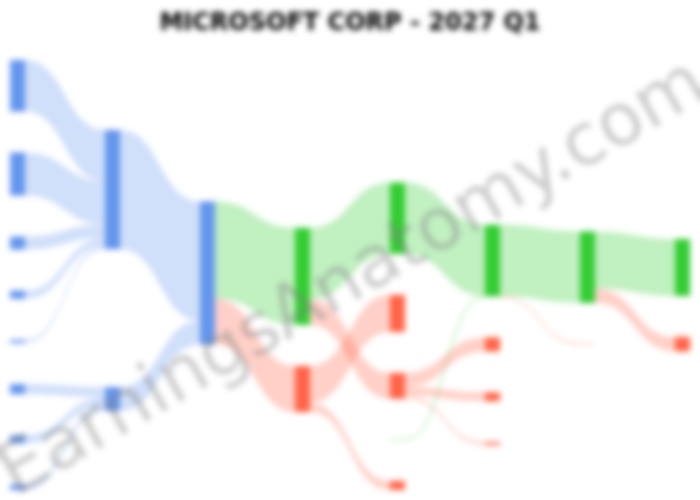
Microsoft reported total revenue of $92.3 billion for the quarter, marking a brisk 19% year-over-year increase from $77.7 billion. Operating income surged 21% to $45.9 billion, delivering an operating margin of nearly 50%.
The filing highlights a streamlined reporting structure centered on two operating divisions: Agents and Infra and Devices and Consumer. Agents and Infra—housing Azure, Microsoft 365 cloud offerings, server licensing, and industry solutions—generated $76.8 billion in revenue (up 25% YoY), accounting for over 83% of the corporate top line. Within this unit, Azure alone delivered $33.2 billion, leaping 48% as enterprise demand for consumption-based computing and GPU-powered artificial intelligence workloads remained relentless.
Conversely, the consumer-facing division, Devices and Consumer—which includes Windows OEM licensing, Surface hardware, Xbox content and gaming services, and Search and advertising—dipped 3% to $15.5 billion. While Search and advertising expanded to $6.6 billion, softer Windows OEM device sales weighed on segment growth. Nonetheless, operating income for the division edged up 2% to $5.4 billion, aided by lower amortization charges following the integration of Activision Blizzard.
Below the operating line, Microsoft recorded net income of $36.6 billion, or $4.92 per diluted share, a 32% rise over the prior-year period. However, headline net income comparisons require a closer look at Other income (expense), net.
The prior-year first quarter was weighed down by a $4.1 billion recognized loss from Microsoft’s stake in OpenAI, the artificial intelligence lab behind ChatGPT in which Microsoft holds a substantial equity and cloud partnership. This quarter saw a positive net gain of $272 million from OpenAI. Excluding these valuation swings, adjusted non-GAAP net income grew by a steadier 18% to $36.4 billion ($4.89 adjusted diluted EPS).
Operating expenses demonstrated disciplined scaling: total OpEx grew just 6% to $16.6 billion, even as headcount fell 2%. Microsoft redirected resources into high-value engineering, driving Research and Development spending up 11% to $9.0 billion to support AI infrastructure and compute capacity.
While bottom-line profitability remains robust, the cash flow statement and footnotes unveil the astronomical cost of constructing modern computing capacity. During the three months ended September 30, 2026, Microsoft deployed $39.4 billion in additions to property and equipment—more than double the $19.4 billion spent during the same period a year earlier.
Even more eye-opening is the company's disclosure on future lease commitments: Microsoft has entered into additional leases—predominantly for datacenters—that have not yet commenced, totaling an unprecedented $364.6 billion scheduled to take effect through fiscal 2034. Alongside a lingering IRS notice disputing $28.9 billion in intercompany transfer pricing for past tax years, Microsoft is committing unprecedented balance-sheet firepower to secure dominant infrastructure positioning against hyperscaler peers. The payoff in Azure revenue is undeniable, but the ongoing capital intensity leaves little room for execution missteps.
Last updated: October 28, 2026
Explore prior quarterly filings, historical revenue breakdowns, and earnings trends.
Microsoft FY2026: $331.8B Revenue, $133.7B Net Income — and an AI Depreciation Wave
Jul 31, 2026
Read
Microsoft Q3 2026 Earnings: Cloud and AI Drive $82.9B Revenue
Apr 29, 2026
Read
Microsoft Q2 2026: Deconstructing the OpenAI Boost and AI Costs
Jan 28, 2026
Read
Microsoft Q1 FY26: Cloud Growth Fuels Revenue as AI Costs Hit Bottom Line
Oct 30, 2025
Read