Loading blog posts...
October 22, 2026 • 4 min read
Income statements can be dense documents, so our goal here is to dig into Meta Platforms, Inc.’s (META) latest quarterly report to see how the business is performing and what key insights we can extract. According to Meta's Q3 2026 10-Q filing, the social media and technology giant continues to generate massive top-line growth from its core advertising engine while simultaneously absorbing enormous legal charges and ramping up historic infrastructure spending to fuel its artificial intelligence (AI) ambitions.
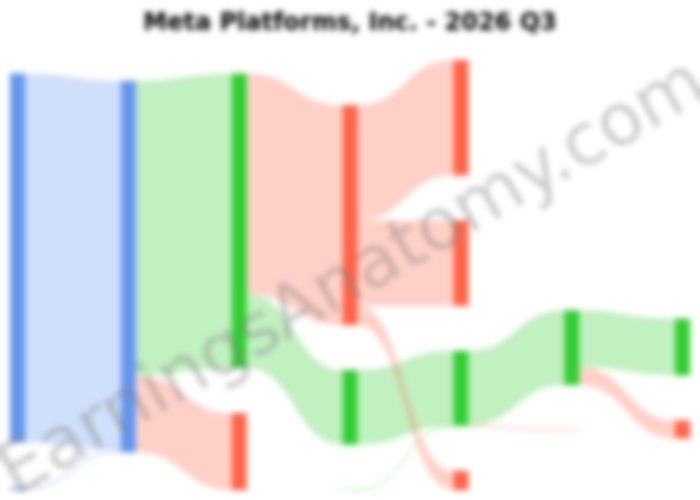
For the third quarter ended September 30, 2026, Meta delivered $64.6 billion in total revenue, up 26% compared to $51.2 billion in the same period last year. However, operating income dropped 37% year-over-year to $13.0 billion, primarily weighed down by a massive legal settlement accrual. Still, thanks to a normalized tax provision compared to a heavy tax hit in Q3 2025, net income more than tripled to $9.9 billion, or $3.83 per diluted share (EPS).
Meta’s business is divided into two reporting segments: Family of Apps (FoA)—which includes Facebook, Instagram, Messenger, Threads, and WhatsApp—and Reality Labs (RL), which houses its virtual, augmented, and mixed reality hardware (like Meta Quest and AI glasses) and software.
The Family of Apps segment remains the undisputed powerhouse, bringing in $64.2 billion (over 99% of total revenue). Advertising accounted for $63.1 billion of that total, jumping 26% year-over-year. This growth was driven by healthy user engagement and stronger monetization:
Meanwhile, Reality Labs continues to require heavy subsidies without near-term top-line payoff. RL revenue slipped 6% year-over-year to $443 million, while the segment posted an operating loss of $4.1 billion—bringing its nine-month operating loss for 2026 to $12.8 billion.
While gross profit remained exceptionally strong at $51.2 billion (a 79.3% gross margin), operating expenses surged, compressing Meta's operating margin from 40% in Q3 2025 down to 20.1% in Q3 2026.
The most dramatic jump occurred in General and Administrative (G&A) expenses, which skyrocketed 323% from $3.5 billion to $14.9 billion. The culprit was a massive $9.89 billion charge tied to an August 2026 multistate attorneys general settlement agreement. Because that charge was allocated to the Family of Apps segment, FoA operating income fell 31% year-over-year to $17.1 billion despite record revenue.
At the same time, Meta is pouring unprecedented capital into R&D and technical infrastructure:
Meta’s Q3 2026 income statement highlights a company with an extraordinarily lucrative core business that gives it the financial firepower to absorb a nearly $10 billion legal hit while simultaneously committing up to $145 billion in annual capital expenditures. Going forward, the central question for investors is whether Meta’s massive bets on AI infrastructure and Reality Labs hardware will generate enough long-term revenue and engagement to justify the escalating depreciation and operating costs hitting its income statement.
Last updated: October 22, 2026
Visual breakdowns and margin trends from recent public company SEC filings.
Norwegian Cruise Line Q3 2026: Higher Net Income Masks Weaker Operations
Oct 30, 2026
Read
Citizens Financial Group (CFG) Q3 2026: NII Expansion & Margin Growth
Oct 30, 2026
Read
Chubb Limited Q3 2026 10-Q Analysis: 84.1% Combined Ratio & $1.79B Investment Income
Oct 30, 2026
Read
MGM Resorts Q3 2026: Operating Profit Rebounds as Adjusted EBITDA Falls 20.4%
Oct 30, 2026
Read