Loading blog posts...
July 31, 2026 • 3 min read
Digging into Meta Platforms' income statement from its latest 10-Q filing offers a clear window into how the tech giant is balancing powerful core business growth against an aggressive push into artificial intelligence and next-generation infrastructure. By unpacking these quarterly figures, we can see how expanding digital advertising demand fuels top-line growth, while rapidly accelerating operating expenses—driven by expanding compute capacity, specialized talent, legal provisions, and workforce restructuring—impact quarterly profitability.
Meta generated $60.80 billion in total revenue for Q2 2026, representing a 28% increase compared to $47.52 billion in Q2 2025. The vast majority of revenue came from the Family of Apps (FoA) segment—comprising Facebook, Instagram, WhatsApp, and Messenger—which generated $60.37 billion (up 28% year-over-year).
Within FoA, digital advertising revenue reached $59.36 billion (+27%), buoyed by a 14% increase in ad impressions delivered across apps and a 12% rise in the average price per ad. Other FoA revenue surged 73% to $1.01 billion, primarily driven by WhatsApp paid messaging. Global user engagement remained solid, with Family Daily Active People (DAP)—a key operational metric measuring unique users across Meta's applications—averaging 3.60 billion in June 2026 (+3% YoY).
Meanwhile, the Reality Labs (RL) division—which develops virtual and augmented reality hardware and software, including Meta Quest headsets and Ray-Ban Meta AI smart glasses—reported $431 million in revenue (+16% YoY).
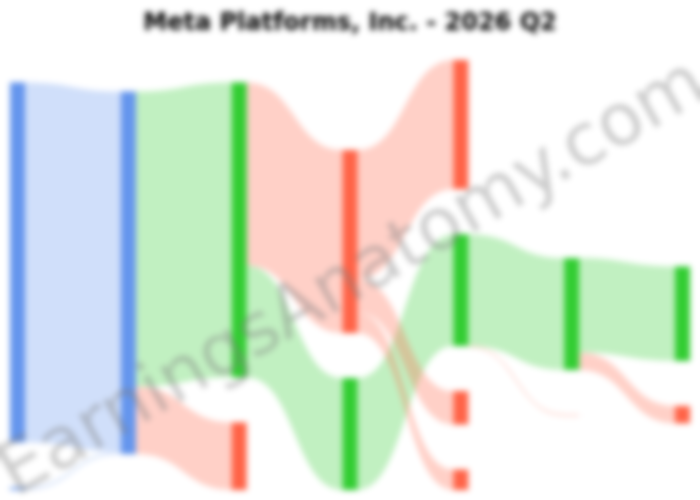
To visualize how Meta's $60.80 billion in Q2 revenue flowed through cost of revenue, operating expenses, and income taxes to yield net income, consider the summary diagram below:
Despite robust revenue growth, total costs and expenses surged 55% year-over-year to $42.03 billion. A major driver was Research and Development (R&D) spending, which jumped 67% to $21.66 billion, reflecting Meta's efforts to recruit technical talent and expand compute capacity for training next-generation AI models. Expenses were further elevated by $2.40 billion in legal charges in General and Administrative (G&A) expenses (which grew 111% to $5.61 billion) and $1.18 billion in severance expenses tied to workforce reductions in May 2026.
As a result, operating income fell 8% year-over-year to $18.78 billion, compressing Meta's operating margin to 30.9% from 43.0% in Q2 2025. Segment operating income for FoA slipped 6% to $23.39 billion, while Reality Labs recorded an operating loss of $4.62 billion. Net income declined 14% to $15.85 billion, yielding diluted earnings per share (EPS) of $6.18, down from $7.14 in Q2 2025.
To support its AI initiatives alongside its core business operations, Meta's quarterly capital expenditures (CapEx, physical assets like servers and data centers, including finance lease principal payments) reached $31.08 billion. For the first six months of 2026, consolidated net cash provided by operating activities totaled $64.09 billion.
In May 2026, the company issued $25.00 billion in senior unsecured debt, bringing long-term debt to $83.66 billion while maintaining $90.26 billion in cash, cash equivalents, and marketable securities. Meta updated its full-year 2026 CapEx guidance to $130 billion–$145 billion, signaling that infrastructure deployment across both core services and AI initiatives will remain at an elevated pace.
Meta's Q2 2026 financial results highlight a clear strategic trajectory: while its core Family of Apps division continues to deliver strong top-line revenue, management is directing substantial capital into buildouts of data centers and next-generation product architectures. Although these investments and temporary restructuring costs currently compress operating margins, Meta is betting that establishing massive compute capacity will secure its competitive edge in AI-driven consumer and enterprise experiences.
Last updated: July 31, 2026
Explore prior quarterly filings, historical revenue breakdowns, and earnings trends.
Meta Q3 2026 10-Q Analysis: 26% Revenue Growth Meets Massive AI CapEx and $9.9B Legal Hit
Oct 22, 2026
Read
Meta Q1 2026 Earnings Analysis: Ad Revenue Surge and Massive AI Bets
Apr 30, 2026
Read
Meta 2025 10-K Analysis: Ad Revenue, Taxes, and the AI Pivot
Jan 29, 2026
Read
Meta Q3 2025: A $19B Tax Hit Masks Strong Growth and Huge AI Spending
Oct 30, 2025
Read