Loading blog posts...
April 30, 2026 • 4 min read
When analyzing a company's financial health, the income statement serves as a direct roadmap of its strategic priorities. Our goal here is to dig into Meta's financial results and unpack the numbers from their latest 10-Q filing to see how their core business is performing and where they are placing their biggest bets for the future.
Meta Platforms, the social media titan behind Facebook, Instagram, and WhatsApp, delivered exceptional top-line numbers for the first quarter of 2026. Total revenue surged to $56.3 billion, a massive 33% increase from the same period last year. However, a deeper look reveals a fascinating dynamic between a highly profitable advertising core, a unique tax situation, and staggering investments in artificial intelligence infrastructure.
The vast majority of Meta's success continues to be driven by its Family of Apps (FoA) segment. This division, which includes its core social media platforms, pulled in $55.9 billion in revenue and generated a remarkable $26.9 billion in operating income. The growth was fueled by incredibly healthy advertising metrics, with ad impressions climbing 19% and the average price per ad increasing by 12%. This signals robust marketer demand and high user engagement across their platforms, supported by the 3.56 billion daily active people interacting with Meta's apps on average in March 2026.
In stark contrast, the Reality Labs (RL) division—Meta's long-term bet on augmented and virtual reality—saw its revenue slightly dip year-over-year to $402 million. Meanwhile, it posted an operating loss of $4.0 billion. While the losses in RL are substantial, they are comfortably subsidized by the immense profitability of the core advertising business.
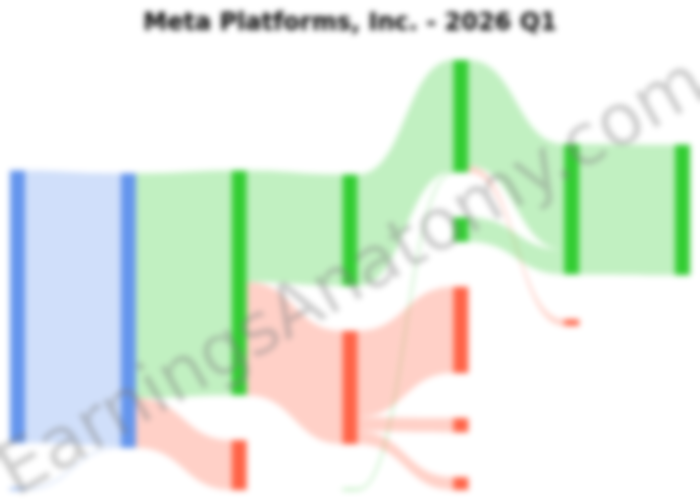
The flow of revenue to profit for the quarter is visualized in the diagram below, showing how the different segments and cost centers contribute to the final net income.
While revenue soared, Meta's spending also accelerated significantly. Research and development expenses jumped 46% to $17.7 billion for the quarter. This aggressive spending reflects the company's strategic pivot towards becoming an AI-first company.
This investment is even more apparent in the capital expenditures, which hit nearly $20 billion for the quarter. Meta anticipates spending a colossal $125 billion to $145 billion in 2026, primarily to build out the AI infrastructure needed to power everything from its ad systems and content recommendations to its future metaverse ambitions. This level of spending underscores a massive bet that dominating the next wave of AI will secure its long-term growth.
The most surprising element of Meta's Q1 report was its bottom line. Net income exploded by over 60% to $26.8 billion. This wasn't just due to strong operational performance; it was supercharged by a $5.0 billion tax benefit. This resulted in an unusual effective tax rate of -23% for the quarter, compared to a 9% tax expense in the same period last year. While the filing doesn't detail the exact cause of this one-time benefit, it's a critical factor in the quarter's stellar net income figure. Investors should note the company expects its tax rate to return to a more normal 13-16% for the remainder of the year.
Meta's first-quarter performance showcases a company operating from a position of immense strength. Its core advertising business is not just growing; it's thriving, generating the massive cash flows needed to fund ambitious, long-term bets on AI and the metaverse. The key challenge ahead will be converting this monumental investment in technology and infrastructure into the company's next major revenue driver, all while navigating a competitive landscape and the distant promise of its Reality Labs vision.
Last updated: April 30, 2026
Visual breakdowns and margin trends from recent public company SEC filings.
Norwegian Cruise Line Q3 2026: Higher Net Income Masks Weaker Operations
Oct 30, 2026
Read
Citizens Financial Group (CFG) Q3 2026: NII Expansion & Margin Growth
Oct 30, 2026
Read
Chubb Limited Q3 2026 10-Q Analysis: 84.1% Combined Ratio & $1.79B Investment Income
Oct 30, 2026
Read
MGM Resorts Q3 2026: Operating Profit Rebounds as Adjusted EBITDA Falls 20.4%
Oct 30, 2026
Read