Loading blog posts...
April 25, 2026 • 3 min read
Let's unpack the numbers from their latest 10-Q filing to see how Las Vegas Sands Corp. (LVS)—a global developer and operator of high-end Integrated Resorts—started 2026 with a massive wave of momentum across its Asian markets.
While the company's name famously references Las Vegas, LVS actually sold off its U.S. properties a few years ago. Today, its entire financial engine relies on its massive, luxury-focused resorts in Macao and Singapore. These properties combine casino gaming with extensive hotel, mall, dining, and convention operations. Based on their first-quarter results, this Asia-centric strategy is paying off in spades.
The first quarter of 2026 was highly lucrative for LVS. Total net revenues grew by an impressive 25.3% year-over-year to reach $3.59 billion, up from $2.86 billion in Q1 2025. This top-line surge translated beautifully to the bottom line, with net income skyrocketing 57.1% to $641 million. The growth was fueled by strong post-pandemic travel demand and a focus on high-value tourism.
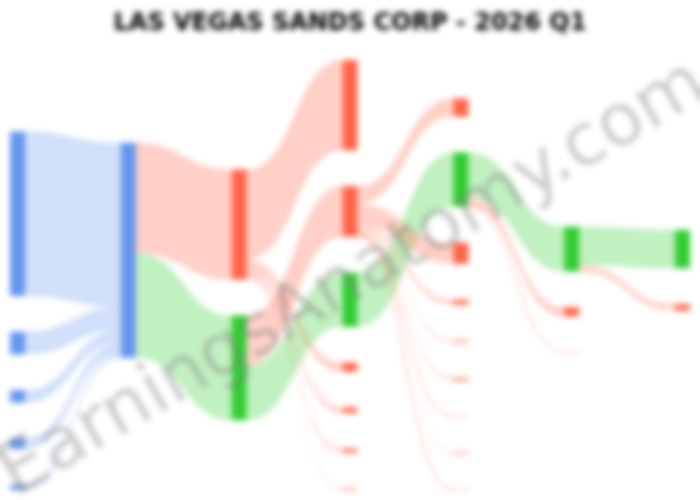
To better visualize how the company's various revenue streams—from casino floors to luxury retail—filter down into actual profit, take a look at the financial flow for the quarter:
The company's performance is driven by two key markets, and each tells a slightly different story.
Marina Bay Sands (Singapore): This property continues to be the crown jewel, posting a 30.2% increase in adjusted property EBITDA to $788 million. The resort is firing on all cylinders, benefiting from strong tourism and its status as a landmark destination. Higher gaming volumes and increased room rates underscore the robust demand in this market.
Macao Operations: The Macao segment saw overall growth, with its combined adjusted property EBITDA rising 18.3% to $633 million. However, the recovery is not uniform across all properties. The Londoner Macao and The Plaza Macao and Four Seasons were standout performers, with EBITDA growth of 45.8% and 54.1%, respectively. This suggests that recent investments in renovating and upgrading these properties to target premium customers are paying off. In contrast, The Parisian Macao saw its EBITDA decline by 30.3%, highlighting the intense competition within the world's largest gambling hub.
Beyond the strong operating numbers, LVS demonstrated confidence in its financial health and future prospects by returning a significant amount of capital to shareholders. During the quarter, the company repurchased $746 million of its common stock and paid $201 million in dividends.
In conclusion, Las Vegas Sands' Q1 2026 results paint a picture of a company successfully executing its Asia-focused strategy. With a dominant performance in Singapore and a targeted, if still competitive, recovery in Macao, LVS is capitalizing on the resurgence of high-end global travel. The key challenge ahead will be navigating the fierce competition in Macao and ensuring its multi-billion dollar investments there continue to generate strong returns across its entire portfolio.
Last updated: April 25, 2026
Explore prior quarterly filings, historical revenue breakdowns, and earnings trends.