Loading blog posts...
July 29, 2026 • 4 min read
Las Vegas Sands is no longer a Las Vegas casino operator in the traditional sense: after selling its U.S. properties, LVS is essentially a Macao and Singapore integrated-resort company, anchored by Sands China’s Cotai Strip resorts and Marina Bay Sands. The goal here is to dig into the income statement from the company’s latest 10-Q filing and see how the business is performing beneath the headline earnings decline.
The short version: Q2 looked softer year over year, but the first half still showed growth. Gaming “hold” volatility — the percentage of wagers the casino keeps — appears to have weighed heavily on the quarter, especially in Macao.
For the three months ended June 30, 2026, LVS reported net revenue of $3.15 billion, down slightly from $3.18 billion a year earlier. That 0.7% decline does not look dramatic, but profitability moved much more sharply:
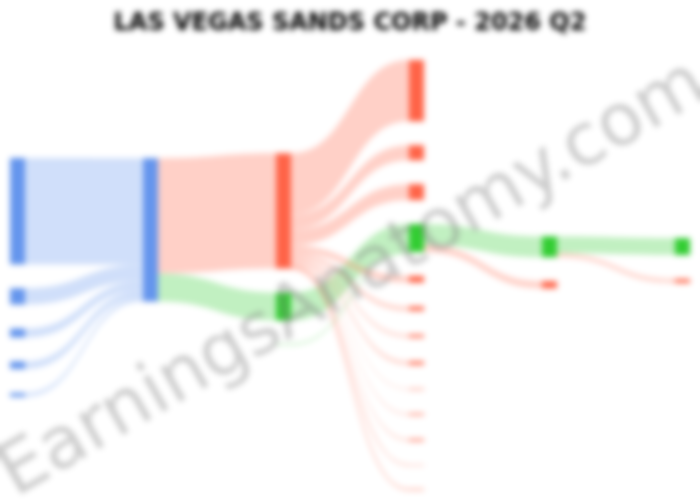
The company’s quarterly income statement flow is summarized below:
The key issue was not demand alone. Casino revenue fell 3.1% to $2.34 billion, even as several wagering volume metrics improved. For example, at The Londoner Macao, non-rolling chip drop rose 17.7%, and rolling chip volume rose 68.6%. At Marina Bay Sands, non-rolling chip drop rose 10.0% and rolling chip volume rose 3.6%.
But win rates moved against LVS. The Venetian Macao’s rolling chip win percentage fell to 0.62% from 3.57%, and The Plaza Macao and Four Seasons Macao posted a negative 1.15% rolling chip win rate. In casino accounting, this kind of hold volatility can create large swings in reported revenue and EBITDA even when customer activity is healthy.
Geographically, Macao generated $1.78 billion of Q2 revenue, while Singapore generated $1.38 billion. But Singapore was far more profitable on a segment basis: Marina Bay Sands produced $689 million of adjusted property EBITDA, compared with $430 million for all Macao operations combined.
That difference matters. Marina Bay Sands produced an implied adjusted property EBITDA margin near 50%, while Macao was closer to 24%. Singapore also showed strength outside the casino floor. Room revenue at Marina Bay Sands rose 12.7% to $151 million, driven by a 10.6% increase in average daily rate to $982 and RevPAR — revenue per available room — of $939, up 11.3%.
Retail also remained resilient. The Shoppes at Marina Bay Sands reported 100% occupancy, with tenant sales per square foot up 15.6% to $3,279. Mall revenue companywide rose 5.9% in Q2 to $198 million, and mall operating economics remain highly attractive: the mall category produced $176 million of operating income on $198 million of revenue.
The pressure on earnings was amplified by higher costs. Total operating expenses rose 6.0% to $2.54 billion. Casino operating expenses increased 8.6% to $1.35 billion, while general and administrative expense rose 13.4% to $331 million.
One notable line item: the provision for credit losses more than doubled to $36 million from $16 million. This reflects expected losses on receivables, including gaming credit extended to patrons. Accounts receivable stood at $622 million net of a $237 million allowance at quarter-end.
Capital allocation remains aggressive. During the first half of 2026, LVS repurchased 28.1 million shares for $1.54 billion and declared $0.60 per share in dividends. The share count impact is meaningful: Q2 basic weighted-average shares fell to 654 million from 695 million a year earlier.
Balance sheet leverage is still an important part of the story. LVS had $3.38 billion of cash and cash equivalents and $15.26 billion of debt at June 30, 2026. Interest expense was $189 million in Q2, only slightly lower than last year, and remains a significant drag on pretax income.
LVS’s Q2 income statement shows a business with strong underlying assets but uneven quarterly results. The first half was better than the quarter: six-month revenue rose 11.6% to $6.74 billion, and net income rose 9.4% to $1.01 billion. Still, Q2 highlights the sensitivity of integrated resorts to gaming hold, credit quality, labor and operating costs, and regional competition.
In a market where LVS competes with major Macao operators such as Galaxy, Wynn Macau, MGM China, and Melco — while Marina Bay Sands remains one of the world’s premier casino-resort assets — the company’s challenge is clear: convert solid visitation and spending trends into more consistent margins and cash flow.
Last updated: July 29, 2026
Explore prior quarterly filings, historical revenue breakdowns, and earnings trends.