Loading blog posts...
January 30, 2026 • 4 min read
For investors watching the semiconductor supply chain, Lam Research Corporation (LRCX) is a critical bellwether. As a leading manufacturer of wafer fabrication equipment, Lam Research provides the complex machinery used by chipmakers like TSMC, Samsung, and Intel to etch and deposit materials on silicon wafers. If chipmakers are expanding, Lam is usually one of the first to know.
We are going to dig into the income statement from the company’s latest 10-Q filing to see how the company is capitalizing on the current semiconductor cycle and what the numbers tell us about the broader market health.
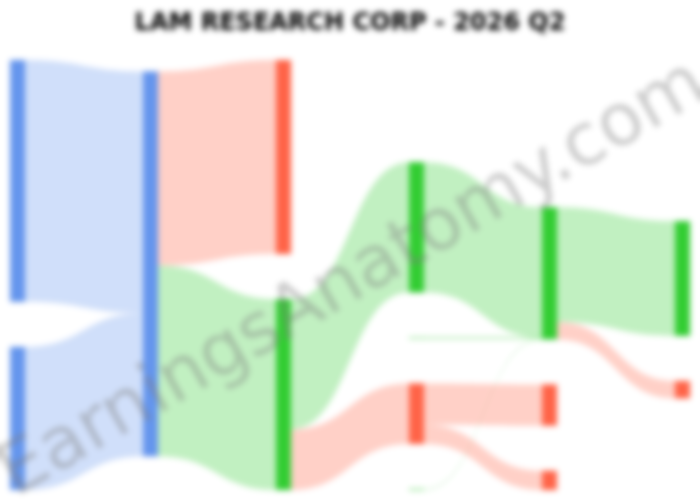
To get a snapshot of how Lam Research converts revenue into profit, the following flow diagram illustrates the movement of capital through the business for the quarter ended December 28, 2025:
Lam Research reported revenue of $5.34 billion for the quarter, a significant jump from $4.38 billion in the same period last year. This 22% year-over-year increase signals robust demand for semiconductor capital equipment.
The geographic breakdown offers perhaps the most interesting insight. China remains the dominant revenue driver, contributing $1.86 billion, or roughly 35% of total revenue. This is a substantial increase from $1.34 billion in the prior year. Despite ongoing export controls and geopolitical tension, Chinese demand for semiconductor manufacturing equipment remains a massive engine for Lam's growth. Korea and Taiwan followed, contributing roughly 20% each.
The company maintained strong profitability metrics. Gross margin came in at $2.65 billion, or 49.6% of revenue. While this is an improvement over the 47.4% recorded a year ago, management noted a slight sequential decrease compared to the September quarter (50.4%), attributing the dip primarily to an unfavorable change in customer mix.
Operating income stood at $1.81 billion, translating to a healthy operating margin of roughly 34%. After taxes, Lam delivered a Net Income of $1.59 billion, or $1.26 per diluted share. This demonstrates the company's high operating leverage; as revenue scales, a significant portion falls to the bottom line.
The semiconductor market is generally divided into two main camps: Memory (chips for storage, like DRAM and NAND) and Foundry/Logic (processors for computing).
Lam’s filing highlights a continued skew toward the Foundry segment, which accounted for 59% of system revenue. This sector includes contract manufacturers producing high-performance chips for AI and mobile applications. Conversely, the Memory segment accounted for 34%. This mix suggests that the current spending cycle is being driven more heavily by logic and processor fabrication—likely fueled by the AI infrastructure build-out—rather than a broad recovery in memory chip prices.
While the numbers are strong, the filing touches on non-trivial risks. The company operates in a complex geopolitical environment. Specifically, the "Risk Factors" section and geographic data underscore the heavy reliance on the China market. Any tightening of export regulations or retaliatory trade measures (such as restrictions on rare earth element exports) could disproportionately impact Lam compared to peers with less exposure to the region.
Furthermore, the semiconductor equipment industry is notoriously cyclical. Lam Research competes fiercely with giants like Applied Materials and Tokyo Electron. To stay ahead, Lam invests heavily in innovation, spending $573 million on Research and Development (R&D) this quarter alone—over 10% of their revenue.
Lam Research's latest quarter paints a picture of a company firing on multiple cylinders, driven by insatiable demand from China and the Foundry sector. With nearly $2 billion in recurring revenue coming just from customer support and upgrades, Lam has built a resilient floor under its volatile equipment sales. However, investors should keep a close eye on trade policies, as the company’s heavy weighting toward China remains its most significant geopolitical vulnerability.
Last updated: January 30, 2026
Explore prior quarterly filings, historical revenue breakdowns, and earnings trends.
Lam Research (LRCX) Q1 FY2027: Revenue Surges 54% as Memory Rebounds
Oct 22, 2026
Read
Lam Research (LRCX) FY26 10-K Analysis: Riding the AI CapEx Wave
Aug 9, 2026
Read
Lam Research Q3 2026 Financial Analysis: Record Revenue Driven by AI Demand
Apr 24, 2026
Read
Lam Research (LRCX) Q3 2025: Foundry and China Fuel Strong Growth
Oct 25, 2025
Read