Loading blog posts...
October 22, 2026 • 4 min read
When a tech giant with over a century of history pivots toward modern artificial intelligence and hybrid cloud, the financial statements quickly reveal whether the strategy is paying off. Today, we are digging into the income statement from International Business Machines Corporation’s (IBM) latest Q3 2026 10-Q filing to see how the business is performing, where its money is coming from, and what we can learn from its recent operational shifts.
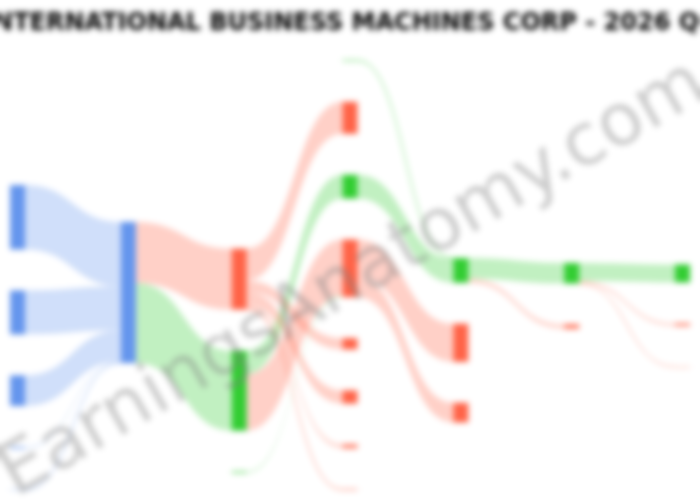
For the third quarter ended September 30, 2026, IBM delivered solid top- and bottom-line growth. Total revenue rose 4.7% year-over-year to $17.1 billion, while net income jumped 25.6% to $2.19 billion (or $2.30 per diluted share). To visualize how revenue from each business line flows through costs and expenses down to the bottom line for the quarter, take a look at the diagram below.
Looking closely at the cost side of the diagram, you will notice $431 million in unallocated cost of revenue. In IBM’s reporting structure, this primarily reflects the amortization of acquired intangible assets ($289 million) and stock-based compensation ($59 million) tied to cost of goods sold that management tracks at the corporate level rather than charging directly to individual business units.
IBM’s Software division—which houses Hybrid Cloud (including Red Hat), Automation, Data, and Transaction Processing—remains the company's primary growth engine and profit center. Software revenue climbed 8.2% year-over-year to $7.8 billion, boasting an impressive 82.5% gross margin and generating $2.73 billion in segment profit.
Within Software, the Data sub-segment was the standout performer, surging 19.1% to $1.74 billion. This jump was heavily bolstered by IBM's recent $11.6 billion acquisition of Confluent, Inc., a data-streaming platform designed to help enterprises connect and process real-time data for AI models. While the deal added over $7.2 billion in goodwill to the balance sheet, it is already visibly accelerating IBM's high-margin software top line.
Meanwhile, IBM’s other divisions showed mixed results:
One of the most revealing takeaways from the income statement is how IBM is managing its operating expenses ($6.83 billion in total). Selling, general, and administrative (SG&A) expenses actually decreased by 2.7% year-over-year to $4.62 billion, even after absorbing new overhead and intangible amortization from acquired businesses. IBM achieved this through internal productivity initiatives and operational streamlining.
Instead of simply pocketing those savings, IBM funneled them directly into innovation. Research and development (R&D) expenses jumped 14.2% to $2.38 billion in Q3. Furthermore, net income received an extra boost from a much lower effective tax rate of 11.9% (down from 28.2% in Q3 2025, which had been weighed down by a $309 million U.S. tax reform charge).
IBM’s third-quarter numbers highlight a company steadily shifting its weight toward high-margin software and AI infrastructure. By aggressively acquiring data capabilities like Confluent and keeping administrative overhead in check, IBM is expanding its software footprint while funding heavy R&D investments. However, with Consulting signings showing mild softness and total debt sitting at $63.8 billion following recent M&A activity, IBM’s ability to convert its growing software and AI pipeline into sustained free cash flow ($7.79 billion through the first nine months) will be the key metric to watch heading into year-end.
Last updated: October 22, 2026
Explore prior quarterly filings, historical revenue breakdowns, and earnings trends.
Visual breakdowns and margin trends from recent public company SEC filings.