Loading blog posts...
October 30, 2026 • 4 min read
Hilton Grand Vacations Inc. (NYSE: HGV) is a premier vacation ownership—commonly known as timeshare—operator that develops, markets, and manages high-end resort properties under the Hilton brand, competing with hospitality heavyweights like Marriott Vacations Worldwide and Travel + Leisure Co. Today, our goal is to dig into the income statement from the company's third-quarter 10-Q filing to see how the business is performing and what we can learn from the numbers. At first glance, HGV appears to have delivered an explosive quarter, with total revenue jumping 50.8% year-over-year to $1.96 billion and net income skyrocketing nearly tenfold to $297 million. However, looking beneath the surface reveals an intriguing accounting dynamic that explains the sudden windfall while highlighting softer underlying sales trends.
The primary driver of HGV’s massive top- and bottom-line expansion in Q3 2026 was the recognition of previously deferred revenue. In the timeshare industry, companies often pre-sell Vacation Ownership Interests (VOIs)—points or intervals backed by physical real estate—while a resort property is still being built. Under U.S. accounting rules, the revenue and direct expenses from these sales must be held back on the balance sheet until construction is complete.
During the third quarter, HGV completed key construction projects, allowing it to recognize $536 million in net deferred VOI sales (compared to deferring $99 million in Q3 2025). This single accounting trigger pushed net VOI sales up to $1.12 billion, compared to $473 million a year ago. After accounting for $152 million in associated cost of sales and $88 million in sales and marketing recognitions, this construction milestone added a net $296 million boost to the quarter's pre-tax profit. Consequently, diluted earnings per share (EPS) soared to $3.70, up from $0.28 in the prior-year period.
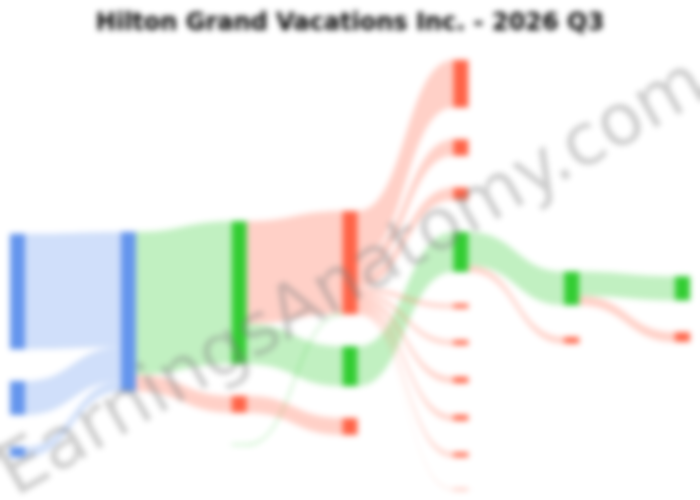
The diagram above illustrates how HGV's Q3 revenue streams flowed through expenses to reach $297 million in consolidated net income ($291 million attributable to stockholders). Notice the $127 million in unallocated revenue alongside the two core divisions; this consists of $153 million in pass-through cost reimbursements—where HGV bills resort owners at cost for property management labor and expenses—partially offset by $26 million in intersegment eliminations for discounted marketing stays between segments.
HGV operates through two core business divisions:
Alongside its operational updates, HGV completed the acquisition of the remaining 75% interest in the Elara resort property for $124 million in net consideration, adding $411 million in net timeshare financing receivables to its balance sheet. Management also remained aggressive with capital returns, repurchasing 2.4 million shares for roughly $112 million during the quarter (and $410 million over the first nine months), leaving $617 million in remaining buyback capacity.
Ultimately, Hilton Grand Vacations’ Q3 income statement highlights the importance of separating accounting timing from real-time demand. While the completion of under-construction inventory delivered a massive earnings windfall and bolstered equity, the 11% dip in contract sales and lower VPG show that HGV—much like peers Marriott Vacations and Travel + Leisure—is navigating a more cautious consumer environment where vacationers are taking tours but spending a bit less at the closing table.
Last updated: October 30, 2026
Explore prior quarterly filings, historical revenue breakdowns, and earnings trends.
Visual breakdowns and margin trends from recent public company SEC filings.