Loading blog posts...
May 1, 2026 • 3 min read
It has been an eventful period for chocolate and snack companies, with shifting consumer tastes and commodity price volatility keeping management teams on their toes. Let's dig into the income statement from The Hershey Company's Q1 2026 10-Q filing to see exactly what happened to revenues, costs, and profits in the first three months of 2026—and what it tells us about where this iconic candy maker stands today.
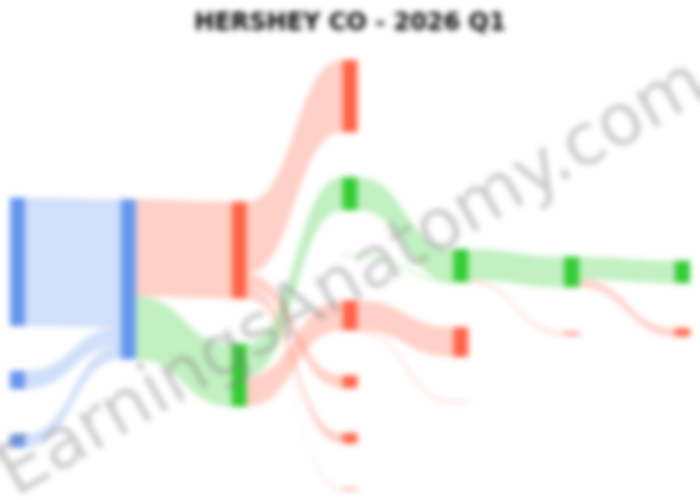
Here's a visual breakdown of how the company's revenue flowed through its costs and expenses to arrive at its net income for the quarter.
The flow diagram above shows a portion of costs that are not allocated to a specific business segment. This is primarily composed of mark-to-market adjustments on the commodity derivative contracts Hershey uses to hedge against price swings in ingredients like cocoa. As we'll see, the change in this specific line item had an outsized impact on the company's profitability this quarter.
Hershey reported net sales of $3.1 billion for the quarter, up a healthy 10.6% from $2.8 billion a year ago.
A massive driver of this top-line growth was the North America Salty Snacks segment, which shot up 26% year-over-year to $350.1 million. This boost is largely tied to Hershey's recent acquisition of LesserEvil, a better-for-you snack brand. The filing details that Hershey acquired roughly $815 million in net assets from LesserEvil, adding significant weight to its growing snack portfolio.
Still, the core North America Confectionery segment—home to Reese's and Hershey's classic chocolate bars—continues to do the heavy lifting. Confectionery brought in $2.5 billion for the quarter, reflecting a solid 8.3% increase in sales.
The real standout in this quarter's results is profitability. Gross profit surged 29.5% to $1.2 billion, expanding the gross margin significantly from 33.7% to 39.4%. How did profits jump so much faster than sales? The cost of sales line only increased by a meager 1.1%.
This improvement is closely linked to how Hershey manages its commodity costs. In Q1 2025, Hershey absorbed a massive $211.5 million hit from unallocated mark-to-market losses on its commodity derivatives. Fast forward to Q1 2026, and those derivative losses shrank to just $30.2 million. This massive $181 million favorable swing relieved immense pressure on the income statement, helping operating profit soar 73.5% to $640.7 million.
Ultimately, Hershey's Q1 2026 performance showcases the success of its diversification into salty snacks and the significant impact of its commodity hedging strategy. While the core confectionery business remains strong, the reduced volatility from derivatives played the starring role in this quarter's impressive profit growth, positioning the company favorably despite ongoing market pressures.
Last updated: May 1, 2026
Explore prior quarterly filings, historical revenue breakdowns, and earnings trends.