Loading blog posts...
July 31, 2026 • 4 min read
The Hershey Company's second quarter of fiscal 2026 produced one of the more dramatic year-over-year swings you'll see from a 130-year-old candy company: net income up more than sevenfold on a sales increase of just 6.6%. Let's dig into the Q2 10-Q to see what's actually driving the numbers — and how much of it is real operating improvement versus accounting mechanics.
Hershey, of course, is the U.S. chocolate leader (Reese's, Hershey's, Kit Kat, Jolly Rancher), and increasingly a salty snacks player (SkinnyPop, Dot's Pretzels, LesserEvil) competing with PepsiCo's Frito-Lay, Mondelez, and Mars.
Net sales rose 6.6% to $2.79 billion, but the profit line exploded: gross profit jumped 58.7% to $1.26 billion, operating profit tripled to $642.6 million, and net income hit $457.7 million versus $62.7 million a year ago. Diluted EPS on common stock came in at $2.26, up from $0.31.
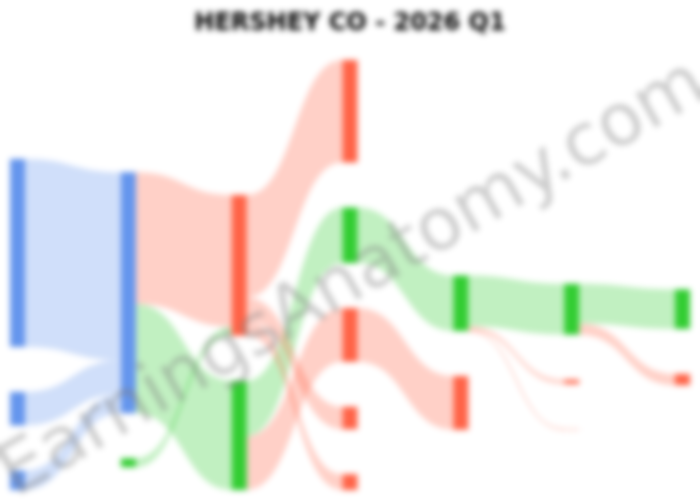
The negative "unallocated cost of revenue" of $102.9 million in the flow above is the key to the story. Hershey hedges cocoa with futures and options, and mark-to-market (MTM) gains and losses — the paper value change on those contracts before the cocoa is actually used — flow through cost of sales but sit outside segment results. This quarter Hershey booked a $102.9 million MTM gain; a year ago it booked a $200.7 million loss. That $303.6 million swing accounts for roughly two-thirds of the $450 million increase in operating profit. On an adjusted basis, Hershey reported EPS of $1.90 (still well ahead of the ~$1.43 consensus), with management noting Q2 sales growth came from ~12% higher pricing against an ~8% volume decline.
Segment income (which reflects realized derivative results, not paper marks) tells a more nuanced story:
Unallocated corporate expense also climbed 18.5% to $215.1 million, and the effective tax rate normalized to 22.2% from an unusual 57.9% (a distortion of last year's tiny pre-tax base).
Six-month operating cash flow nearly doubled to $888.1 million. Hershey used it: $574.4 million of dividends and $439.4 million of buybacks (versus zero in the prior-year period), leaving $270.1 million of authorization remaining. Cash fell to $791.2 million while short-term debt rose to $421.5 million, including $264.3 million of freshly issued commercial paper at 3.7%. Inventories built to $1.74 billion from $1.43 billion at year-end — normal seasonal Halloween-and-holiday stocking, but worth watching given the 8% volume decline. Interest income halved to $5.8 million, pushing net interest expense up 8.5%.
Hershey's quarter shows a company successfully pricing through a cocoa shock — but the two levers that produced the profit surge (favorable derivative marks and double-digit pricing against falling volumes) are both finite. The filing's risk factors flag exactly this tension: price increases "may result in sales volume declines associated with pricing elasticity," alongside tariff and raw-material exposure. Meanwhile, the salty snacks bet that's supposed to diversify away from cocoa is currently diluting margins. Management raised full-year guidance and expects Q3 to show the year's strongest earnings growth as it laps peak cocoa costs and 2025 tariffs — making the next two quarters the real test of whether the operating story can stand on its own.
Last updated: July 31, 2026
Explore prior quarterly filings, historical revenue breakdowns, and earnings trends.