Loading blog posts...
February 18, 2026 • 4 min read
The Hershey Company (HSY), the Pennsylvania-based confectionery giant, is a bellwether for the consumer staples sector. Known globally for its chocolate and sugar confectionery, the company also operates a growing portfolio of salty snacks. However, looking at the numbers from their latest 10-K filing, the fiscal year ended December 31, 2025, reveals a stark financial reality: while consumers are still buying treats, the cost to produce them has risen dramatically, putting significant pressure on the company's bottom line.
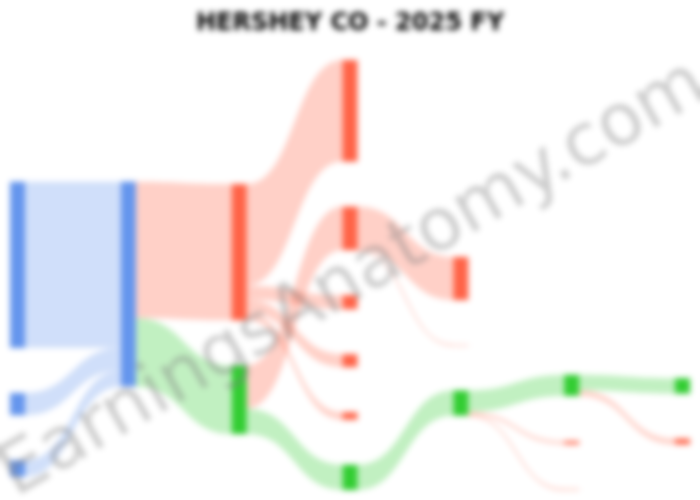
To visualize how revenue trickled down through costs and expenses this year, here is a flow diagram of Hershey's income statement.
The headline narrative for Hershey’s 2025 fiscal year is a massive divergence between top-line growth and profitability. The company reported Net Sales of $11.69 billion, representing a solid 4.4% increase from the previous year. However, the cost to generate those sales rose at a much faster rate.
Cost of Sales surged by 31.7% year-over-year, climbing to $7.77 billion. This disproportionate rise caused Hershey's gross margin—the percentage of revenue retained after direct production costs—to contract significantly. Gross margin fell from 47.3% in 2024 to 33.5% in 2025.
While the filing does not provide a detailed narrative breakdown of these costs, the "Quantitative and Qualitative Disclosures About Market Risk" section highlights extreme volatility in key commodities. Notably, the annual average futures contract price for Cocoa rose to $3.65 per pound in 2025, up from $3.45 in 2024 and just $1.49 in 2023. With cocoa prices reaching highs of $4.89 during the year, the input cost environment for a chocolate manufacturer has been historically difficult.
Beyond physical ingredients, Hershey’s profitability was heavily impacted by the financial instruments used to manage price risk. Manufacturers often use commodity derivatives to hedge against fluctuating prices. However, the accounting for these instruments can lead to significant swings in reported profit.
In 2025, the company recorded a $423.2 million loss in "Unallocated mark-to-market losses on commodity derivatives." This stands in sharp contrast to 2024, when the company recorded a $460.4 million gain on these same instruments. This year-over-year swing of nearly $884 million was a major factor driving Operating Profit down 50.3% to $1.44 billion.
The financial pressure was not felt evenly across Hershey's business divisions.
Hershey continues to utilize capital to expand its portfolio, particularly in areas that diversify its revenue base. On November 18, 2025, the company completed the acquisition of LesserEvil, LLC for a total consideration of $815.2 million. The purchase price allocation suggests significant value in the brand itself, with $303 million allocated to indefinite-lived trademarks and $301.5 million to customer relationships.
This follows the acquisition of the Sour Strips brand earlier in the quarter (November 8, 2024), further signaling Hershey's intent to broaden its reach within the snacking aisle.
Hershey’s 2025 results illustrate the vulnerability of food manufacturers to commodity inflation and financial market volatility. While the company successfully grew its top line and saw impressive double-digit growth in its Salty Snacks division, the historic rise in cocoa costs and unfavorable swings in derivative valuations weighed heavily on the bottom line. Net Income ultimately fell 60.2% to $883 million, creating a complex year for the confectionery leader.
Last updated: February 18, 2026
Explore prior quarterly filings, historical revenue breakdowns, and earnings trends.