Loading blog posts...
October 30, 2026 • 3 min read
Hasbro’s third-quarter income statement shows more than strong gaming sales: its toy business also became substantially more profitable. A closer look at the company’s 10-Q for the quarter ended September 27, 2026 helps explain how revenue growth of 15% translated into a 69% increase in earnings attributable to Hasbro—and where that improvement was concentrated.
Hasbro owns toy and game brands including Monopoly, Play-Doh and Transformers, alongside Wizards of the Coast, home to Magic: The Gathering and Dungeons & Dragons.
Quarterly revenue reached $1.60 billion, up from $1.39 billion a year earlier. Operating profit increased 51.7% to $517.3 million, lifting operating margin—the share of revenue left after operating costs—from 24.6% to 32.4%.
Earnings attributable to Hasbro totaled $394.5 million, versus $233.2 million, while diluted earnings per share rose to $2.77 from $1.64.
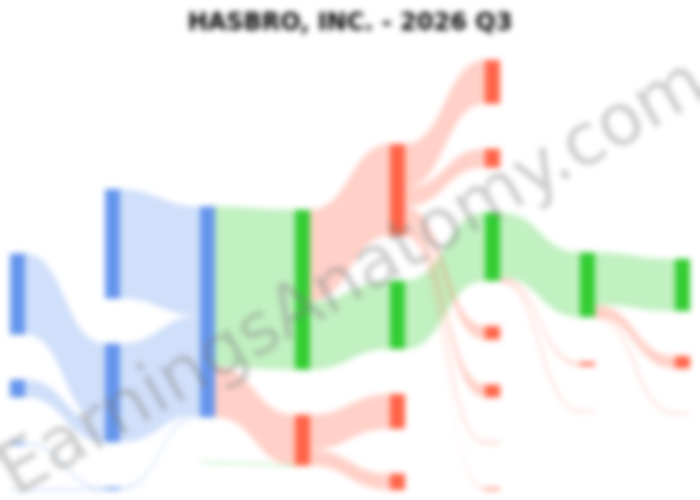
The quarterly revenue-to-profit breakdown illustrates the improvement:
Cost of sales fell 7.1% to $384.8 million, despite higher revenue. Advertising also declined, by $12.1 million. Those savings helped offset higher royalties, product development spending and selling, distribution and administration expenses.
Importantly, the diagram’s 75.9% gross margin subtracts only cost of sales: royalties and several other product-related expenses appear farther downstream. Operating margin is therefore the more comprehensive measure of profitability here.
Growth was not coming from every revenue stream. Net sales rose 17.5% to $1.45 billion, while licensing revenue declined 5.4% to $144.3 million.
Wizards of the Coast and Digital Gaming generated $747.2 million in revenue, up 30.6%, and $367.4 million in operating profit. Its 49.2% operating margin helped it produce about two-thirds of reportable-segment operating profit before corporate expenses.
The standout was tabletop gaming, with revenue up 38.8% to $613.1 million. Digital and licensed gaming grew a more modest 3% to $134.1 million. Tabletop alone supplied roughly 82% of Hasbro’s total year-over-year revenue increase.
That concentration aligns with Hasbro’s October earnings release, which reported that Magic: The Gathering surpassed $600 million in quarterly revenue for the first time.
Consumer Products offered a different improvement: revenue increased just 3.9% to $827.9 million, but operating profit more than doubled to $173.8 million. Its operating margin expanded from 10.1% to 21.0%, supported by lower cost of sales and managed expenses. However, quarterly segment profit exceeded its $111.8 million nine-month total, underscoring how uneven results have been across the year.
Corporate and other expenses partly offset these gains, swinging from $2 million of income to $41 million of expense.
Nine-month earnings attributable to Hasbro recovered to $753.8 million, from a $524 million loss. That turnaround needs context: the prior-year period included a $1.02 billion goodwill impairment, a noncash write-down of acquisition-related value. Neither third quarter included that charge, making the quarterly improvement less distorted by this item.
Cash generation also strengthened: nine-month operating cash flow rose to $907.3 million from $490 million.
The takeaway is twofold: tabletop gaming supplied most incremental sales, while Consumer Products delivered meaningful profitability improvement. Against toy competitors such as Mattel and LEGO, sustaining that broader margin recovery matters alongside Magic’s momentum. Hasbro also flags retailer concentration, seasonality and electronic-data compromise as risks—reasons not to treat one strong quarter as a full-year run rate.
Last updated: October 30, 2026
Explore prior quarterly filings, historical revenue breakdowns, and earnings trends.