Loading blog posts...
July 31, 2026 • 3 min read
Hasbro (HAS), the iconic toy and game company behind brands like Monopoly, Transformers, and Magic: The Gathering, recently posted its Q2 2026 results. After a rocky 2025, the overarching question for investors has been whether the company can successfully transition toward a more profitable, digital-first, and IP-driven model. Let's dig into the numbers from their latest 10-Q filing to unpack the income statement, see how things are going, and what we can learn about their ongoing strategic pivot.
When examining Hasbro's financials, it becomes immediately clear that the company is no longer just a traditional toy manufacturer. The Wizards of the Coast and Digital Gaming (WotC) segment—which houses juggernauts like Magic: The Gathering and Dungeons & Dragons—is the undisputed engine of the company.
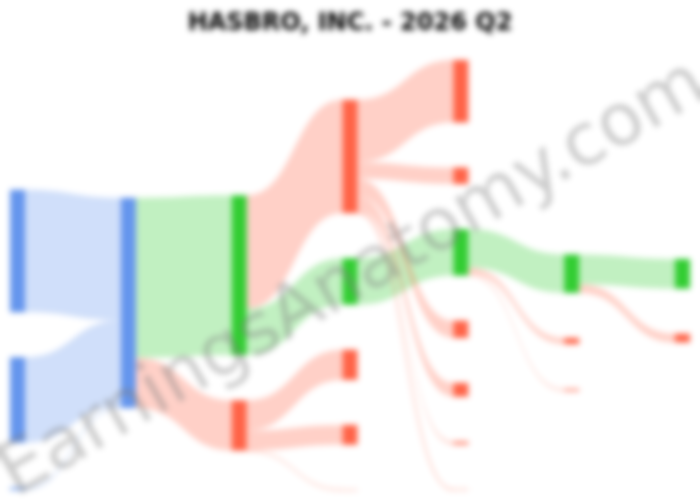
In Q2 2026, this segment generated $663.8 million in revenue, a massive 27.1% jump from the same period last year. More importantly, this division operates with stellar margins, contributing $270 million in operating profit. The growth here was heavily fueled by a 30% surge in Tabletop Gaming revenues, proving that physical card games and role-playing ecosystems still possess immense pricing power and fierce customer loyalty.
To truly appreciate the Q2 2026 net income of $161.3 million (or $1.12 per diluted share), we have to look at the massive crater from Q2 2025. Last year, Hasbro reported a staggering net loss of $854.7 million for the quarter. This was primarily driven by a $1.02 billion goodwill impairment charge linked to its Consumer Products division. In accounting terms, a goodwill impairment means the company had to recognize that the underlying value of assets it previously acquired or held had significantly declined—in this case, reflecting a tough macroeconomic environment for traditional toys.
With that write-down in the rearview mirror, the Consumer Products segment has stabilized. It generated $463 million in revenue this quarter, up a modest 4.7% year-over-year. However, despite the top-line stabilization, the segment still posted an operating loss of $14.5 million. This highlights the ongoing structural challenges and tighter margins inherent in the physical toy market, where raw materials, freight, and supply chain logistics eat heavily into profits.
Hasbro’s Entertainment segment—now a much smaller piece of the pie following the divestiture of its eOne film and TV business a few years prior—brought in just $12.8 million in revenue. However, it remains highly profitable on a percentage basis, yielding $5.6 million in operating profit.
Perhaps the most intriguing forward-looking nugget from the filing is the launch of "Sixth Wall Studio." This new AI-focused studio is dedicated to bringing Hasbro's iconic characters into the artificial intelligence era through emerging channels like behavioral licensing. It’s a clear signal that management is looking to aggressively monetize its vast vault of intellectual property without taking on the heavy capital expenditures of traditional media production.
Hasbro is navigating a complex transition. Unlike its historical rival Mattel, which currently leans heavily into tentpole theatrical releases (like the Barbie movie) to drive traditional consumer product sales, Hasbro is increasingly reliant on the high-margin, sticky ecosystem of digital and tabletop gaming. If Wizards of the Coast continues its robust growth and the traditional toy business can finally climb back to break-even, Hasbro's ongoing strategic turnaround may finally start looking like a decisive victory.
Last updated: July 31, 2026
Explore prior quarterly filings, historical revenue breakdowns, and earnings trends.