Loading blog posts...
February 26, 2026 • 3 min read
Hasbro is widely known as the legacy toymaker behind Transformers, NERF, and Play-Doh, but today, it is functioning more like a massive intellectual property and gaming engine. Let's unpack the numbers from their 2025 annual 10-K filing to see how the company is navigating the complex transition from manufacturing physical toys to licensing digital gaming worlds.
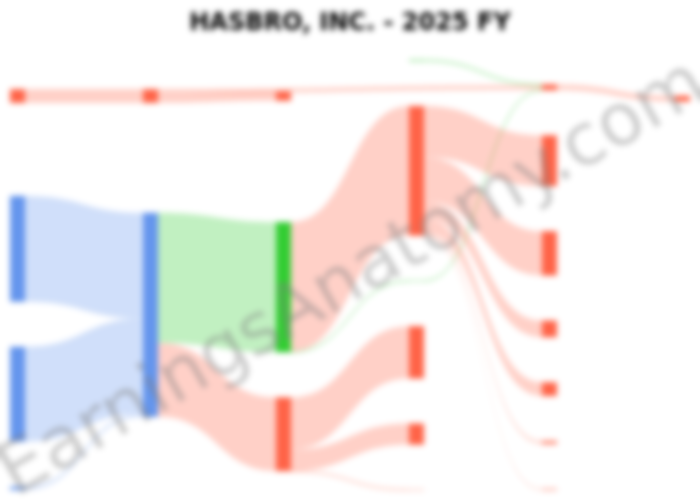
To get a clear picture of how money moves through the company, from top-line sales down to the bottom line, take a look at this structural breakdown of their annual results:
At first glance, Hasbro had a stellar year on the top line. The company reported total net revenues of $4.70 billion for 2025, a robust 13.7% jump from 2024. However, looking at the income statement by segment reveals a business moving in two vastly different directions.
The Wizards of the Coast and Digital Gaming segment is the undisputed growth engine. This division, which houses Magic: The Gathering and Dungeons & Dragons, saw revenues skyrocket 44.7% to $2.19 billion. Even more impressive is its profitability, generating $1.01 billion in operating profit. A massive driver of this success is high-margin digital licensing, specifically the runaway success of the mobile game Monopoly Go! (developed by their partner Scopely). This proves that Hasbro's most lucrative opportunities increasingly lie in leasing its IP to digital developers rather than dealing with the logistics of physical goods.
If revenue was up nearly 14%, why did Hasbro report a net loss of $318.2 million for the year? The answer lies in a massive, non-cash accounting charge: Goodwill Impairment.
In financial terms, goodwill is the premium a company pays over the fair value of tangible assets when it acquires another business. If that acquired unit later underperforms expectations, accounting rules require the company to "write down" that premium to reflect reality. In 2025, Hasbro took a staggering $1.02 billion impairment charge explicitly tied to its Consumer Products reporting unit. This paper loss effectively wiped out the company's operating gains for the year, dragging total operating profit down to a razor-thin $11.1 million, compared to $690 million the prior year.
That billion-dollar write-down highlights a broader structural issue: the traditional toy business is losing momentum. The Consumer Products segment—the classic physical toy business—saw revenues decline 4.2% to $2.44 billion.
In their filing, Hasbro acknowledges the shifting landscape, highlighting the "aging up" of their consumer base—noting that consumers aged 13 and above are gaining purchase share. Furthermore, the company explicitly lists Artificial Intelligence as a risk factor that is likely to increase competition in the digital entertainment markets they are rushing to conquer.
Hasbro finds itself in a fascinating transition phase. Much like its chief rival, Mattel, Hasbro is actively trying to pivot from a traditional manufacturer reliant on overseas supply chains into a capital-light, IP-driven entertainment company.
While the legacy Consumer Products division is dragging down the balance sheet with heavy write-downs and declining sales, the digital and tabletop gaming segments are generating immense cash flow. The 2025 income statement makes one thing abundantly clear: Hasbro's financial future isn't tethered to molded plastic in cardboard boxes; it is firmly bound to digital screens and premium experiences tailored for older, higher-spending fans.
Last updated: February 26, 2026
Explore prior quarterly filings, historical revenue breakdowns, and earnings trends.