Loading blog posts...
February 8, 2026 • 4 min read
Oil prices fluctuate, rig counts shift, and for oilfield services giants like Halliburton (HAL), staying profitable requires constant adaptation. In this post, we are going to unpack the numbers from Halliburton’s latest 10-K filing for the fiscal year ended December 31, 2025. The goal is to look beyond the headlines and understand how a challenging macro environment—marked by lower oil prices and reduced drilling activity—impacted the company's income statement.
For those new to the sector, Halliburton provides the products and services that allow energy companies to construct and operate oil and gas wells. If an exploration company wants to drill a hole or hydraulically fracture ("frack") a well, they call Halliburton, or its main rivals like SLB (formerly Schlumberger) and Baker Hughes.
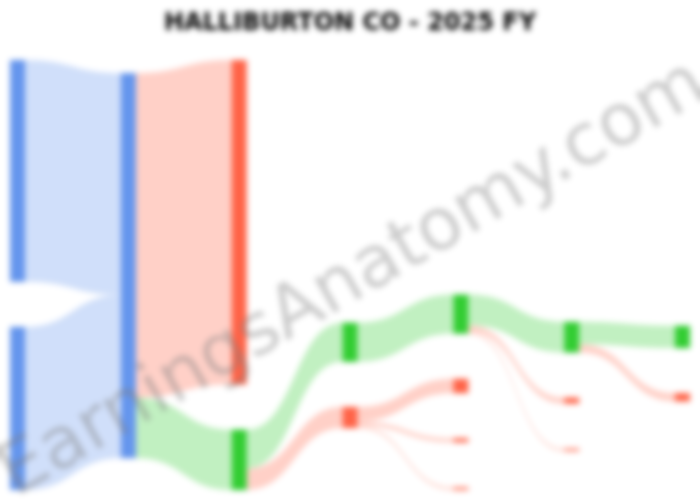
To visualize how revenue trickled down to the bottom line in 2025, take a look at the flow of their financials below:
The top-line story for 2025 is one of contraction. Total revenue slipped to $22.2 billion, a decrease of 3% compared to the previous year. This decline correlates directly with the broader industry environment; the average price of West Texas Intermediate (WTI) crude oil dropped from roughly $76 in 2024 to $65.46 in 2025, leading to a reduction in the worldwide rig count.
Halliburton operates through two primary segments, both of which saw declines:
While a 3% revenue drop is manageable, the impact on profitability was far more severe. Operating income plummeted 41% to $2.26 billion, down from $3.82 billion the year prior.
Why such a steep drop in profit on a modest drop in sales? The answer lies in significant "Impairments and other charges." In accounting terms, an impairment occurs when a company acknowledges that certain assets (like equipment or real estate) are no longer worth their carrying value on the balance sheet and must be written down.
In 2025, Halliburton recorded $831 million in such charges, a massive increase from just $116 million in 2024. This included:
Additionally, the company is undergoing a significant digital transformation, recording $154 million in expenses related to an SAP S4 software upgrade. While these costs hurt the bottom line today, the software upgrade is intended to streamline operations in the future.
The filing also reveals a shifting map of global energy activity. North America, traditionally Halliburton's stronghold, saw revenue decline by 6%, driven by the slowdown in U.S. Land activity. Latin America and the Middle East/Asia regions also contracted.
However, there was a notable bright spot: Europe/Africa/CIS revenue jumped 12% to $3.35 billion. This suggests that while U.S. shale is tapping the brakes, certain international offshore and mature conventional markets are seeing renewed investment.
Halliburton’s 2025 fiscal year was a period of recalibration. Net income attributable to the company fell to $1.28 billion ($1.50 per share), roughly half of the $2.5 billion generated in 2024.
Despite the earnings hit, Halliburton maintained its commitment to returning cash to shareholders, repurchasing roughly $1.0 billion of its common stock. The heavy impairment charges and severance costs signal that management is rightsizing the ship to navigate a lower-price environment. As North American customers maintain strict budget discipline, Halliburton’s ability to pivot toward international growth pockets and manage its cost base will be critical in 2026.
Last updated: February 8, 2026
Explore prior quarterly filings, historical revenue breakdowns, and earnings trends.
Halliburton Q3 2026 10-Q: International Drilling and Data Center Power Boost Profits
Oct 23, 2026
Read
Halliburton Q2 2026: Revenue Growth Masked by Nonrecurring Credits
Jul 25, 2026
Read
Halliburton Q1 2026 10-Q Analysis: Margin Expansion & Regional Shifts
Apr 25, 2026
Read
Halliburton Q2 2025 Results: Navigating Market Headwinds
Jul 28, 2025
Read