Loading blog posts...
February 4, 2026 • 4 min read
The global chemical industry often acts as a canary in the coal mine for the broader manufacturing economy, and judging by the latest 10-K filing from Dow Inc. (DOW), the atmosphere remains challenging. Dow, a materials science leader spun out of the DowDuPont merger in 2019, produces plastics, industrial intermediates, and coatings essential to packaging, infrastructure, and mobility.
In its 2025 annual report, the company revealed a difficult fiscal year characterized by pricing pressures, significant asset write-downs, and a swing to a net loss. Let’s unpack the income statement to understand where the money came from and, more importantly, where it went during a turbulent year.
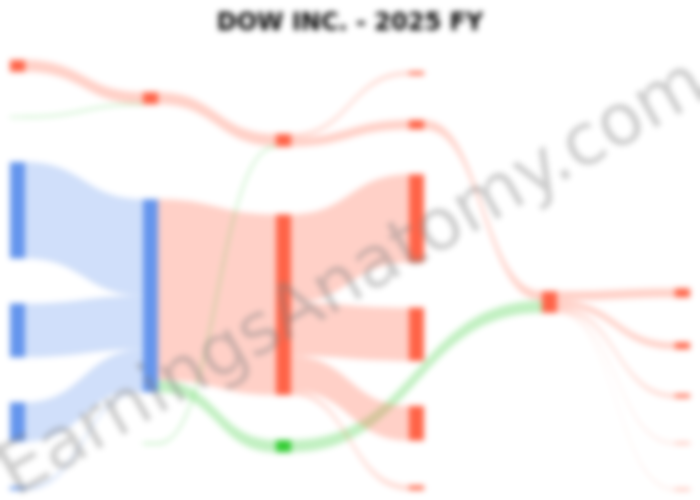
To get a clear picture of how Dow’s $39.97 billion in revenue translated—or failed to translate—into bottom-line profit, take a look at the flow diagram below. This visualization tracks money from top-line sales, through the various costs of manufacturing and operations, down to the final net result.
Dow reported Net Sales of $39.97 billion, a decrease of approximately 7% from $42.96 billion in 2024. The primary culprit was not a lack of demand—volume was flat—but rather pricing power. Local prices dropped 7% due to lower feedstock costs and global supply-demand imbalances.
However, the most striking aspect of the income statement is the bottom line. Dow swung from a Net Income of $1.2 billion in 2024 to a Net Loss of $2.44 billion in 2025. This equates to a loss of $3.70 per share.
While cost of sales decreased slightly to $37.4 billion, it wasn't enough to offset the drop in revenue and the massive increase in "Restructuring, goodwill impairment and asset related charges," which ballooned from $103 million in the prior year to $1.86 billion in 2025.
Dow operates through three primary segments, all of which faced headwinds:
The heavy losses in 2025 were largely driven by non-operational charges as Dow attempts to resize its footprint.
Goodwill Impairment: The company recorded a $690 million non-cash charge related to its Polyurethanes & Construction Chemicals reporting unit. In financial terms, "goodwill" is the premium paid for an acquisition over its tangible value. An impairment means the company acknowledges that the acquired business is no longer worth what is listed on the books, usually due to diminished future cash flow expectations.
2025 Restructuring Program: Dow is aggressively cutting capacity in high-cost regions. The filing details the shutdown of an ethylene facility in Böhlen, Germany, and chlor-alkali assets in Schkopau, Germany. Additionally, they are closing a siloxanes plant in the UK. These moves triggered substantial asset write-downs and severance costs, contributing to the $1.86 billion charge mentioned earlier.
Dow’s 2025 performance reflects a cyclical trough in the petrochemical industry, exacerbated by high energy costs in Europe and massive capacity additions in China affecting global pricing. Competitors like LyondellBasell and BASF are navigating similar choppy waters, managing capacity against soft industrial demand.
Management's response has been to shrink the asset base and preserve cash—evidenced by the dividend reduction announced in mid-2025. As the company enters 2026, the focus remains on its "Transform to Outperform" strategy, hoping that a leaner footprint in Europe and cost discipline will return the materials giant to profitability once the cycle turns.
Last updated: February 4, 2026
Explore prior quarterly filings, historical revenue breakdowns, and earnings trends.
Dow Inc. Q3 Earnings Analysis: Pricing Power Drives Operational Rebound
Oct 23, 2026
Read
Dow Inc. Q2 2026 Earnings: Pricing Power Drives $802M Net Income
Jul 28, 2026
Read
Dow Inc. Q1 2026 10-Q Analysis: Navigating a Cyclical Downturn
Apr 25, 2026
Read
Dow Q3 2025: Sales Slump and Squeezed Margins Prompt Restructuring
Oct 27, 2025
Read